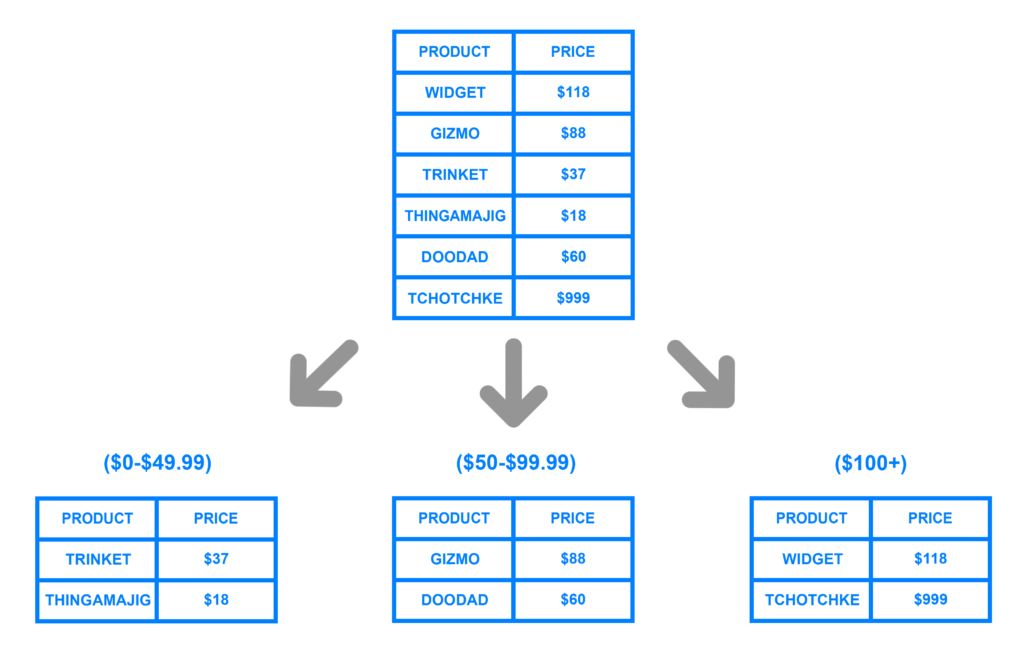
Data sharding is a technique frequently utilized in the realm of Big Data to distribute large datasets across multiple servers, enabling efficient processing and analysis of massive volumes of information. This fragmentation approach involves dividing the dataset into smaller, more manageable parts, known as shards, and storing them on separate nodes within a distributed computing environment. By distributing the workload across multiple servers, data sharding enhances parallel processing capabilities, accelerates query performance, and optimizes resource utilization within Big Data systems. This method ultimately enables organizations to handle petabytes of data more effectively, ensuring scalability, resilience, and improved performance in data-intensive applications.
Data sharding is a vital concept in the realm of Big Data architecture and management. It refers to a specific method of partitioning a data set into smaller, more manageable pieces, known as shards. Each shard is an independent database that can be hosted on different servers, allowing for improved performance and scalability. As organizations grapple with increasing volumes of data, understanding how data sharding operates becomes essential in optimizing data handling and boosting application efficiency.
Understanding Data Sharding
Sharding is primarily aimed at managing large databases. When a single database becomes too large to work with efficiently, sharding breaks it down into smaller components that can be processed independently. Each shard represents a portion of the overall dataset, and together they form a complete database. The key advantages include:
- Increased Performance: By distributing the data across multiple servers, search and retrieval processes can be executed in parallel.
- Scalability: New shards can be added easily as data volume increases, allowing systems to scale horizontally.
- Better Data Management: Smaller data pieces are easier to manage, backup, and recover in case of failures.
How Data Sharding Works
Data sharding operates on the principle of splitting data horizontally across multiple databases or instances. Here’s a breakdown of how it works:
1. Choosing a Sharding Key
The first step in implementing data sharding is selecting a sharding key. A sharding key is a specific attribute or field that dictates how data is distributed across shards. Choosing the right sharding key is critical, as it impacts the performance and accessibility of the data. Common types of sharding keys include:
- Range-based Sharding: Distributes data into shards based on a range of values. For example, users with IDs between 1-1000 might go to one shard, while IDs 1001-2000 go to another.
- Hash-based Sharding: Uses a hashing algorithm to assign data to shards based on the hash value of the sharding key. This method helps to evenly distribute data across shards.
- Directory-based Sharding: Maps specific data items to specific shards using a lookup table or directory, offering flexibility in data allocation.
2. Data Distribution
Once a sharding key is selected, the data can be distributed among the shards. Each shard operates as an independent database instance, allowing for transactions and querying specific to that shard. This distribution means that whenever a query is made, it can access only the relevant shard instead of searching through the entire dataset, significantly reducing query time and enhancing overall performance.
3. Query Routing
In a sharded database setup, a query router is employed to direct queries to the appropriate shard. The query router intercepts incoming requests and uses the sharding key to determine which shard to target. A well-designed router should effectively manage load balancing and failover processes, ensuring that the system remains stable and efficient. This routing can provide seamless user experiences even when datasets are extraordinarily large.
Benefits of Data Sharding in Big Data
The implementation of sharding offers several significant benefits for managing big data:
1. Enhanced Performance and Speed
Data sharding allows systems to distribute workloads effectively. By splitting massive data volumes, the overall load on a single server is reduced, thereby enhancing the speed of data retrieval and processing. This results in faster response times for end users and improves overall system performance.
2. Improved Fault Tolerance
Sharding inherently supports fault tolerance. If one shard fails or experiences downtime, the other shards continue to operate normally. This redundancy ensures that the entire system does not go down and that data remains accessible. Additionally, backups can be performed shard by shard, reducing the risk of data loss.
3. Scalability and Flexibility
As businesses expand and data volumes grow, sharding allows for simple scaling. New shards can be added without requiring major reconfigurations of the existing architecture. This horizontal scaling capability enables organizations to handle data growth efficiently and adapt quickly to changing data demands.
4. Cost Efficiency
By using commodity hardware for individual shards, organizations can effectively manage operational costs. Instead of investing heavily in powerful servers, you can use multiple less expensive machines to handle the workload cost-effectively.
Challenges of Data Sharding
While data sharding offers numerous advantages, it is not without its challenges:
1. Complexity in Implementation
Implementing a sharded architecture involves significant complexity. The database design, query routing, and application logic must be carefully managed to ensure proper functionality across multiple shards. This complexity often leads to increased developmental and operational overhead.
2. Uneven Data Distribution
If the chosen sharding key does not evenly distribute data, some shards may become overloaded, while others remain underutilized. This imbalance can negate the performance benefits of sharding and lead to bottlenecks.
3. Cross-Shard Queries
Executing queries that span multiple shards can be complicated, requiring either complex join operations or additional logic in application code. These cross-shard queries often incur performance penalties, as they negate some of the benefits gained through sharding.
4. Migrating Existing Data
Migrating an existing monolithic database setup to a sharded architecture can be challenging. Data migration strategies must be well-planned and executed to ensure minimal downtime and data integrity.
Best Practices for Data Sharding
To maximize the benefits of data sharding while mitigating potential issues, consider the following best practices:
- Carefully Select Sharding Keys: Analyze your data access patterns to determine the most effective sharding key that will lead to balanced shards and improve performance.
- Monitor Data Distribution: Regularly monitor the data distribution across shards to identify and correct any imbalances that may negatively impact performance.
- Implement Comprehensive Testing: Ensure thorough testing of your sharded architecture for both performance and data integrity, especially in transition phases from a non-sharded setup.
- Leverage Automation: Consider automation tools that can simplify shard management tasks, such as data migrations, backups, and performance monitoring.
Conclusion
In summary, data sharding is a powerful technique for effectively managing big data. By breaking large databases into smaller, more easily manageable components, organizations can achieve improved performance, scalability, and fault tolerance. However, like any technology, it comes with challenges, necessitating careful planning and execution. Understanding both the potential and pitfalls of data sharding is essential for effectively leveraging big data architectures.
Data sharding is a technique used in Big Data to horizontally partition large datasets across multiple nodes for improved performance and scalability. By distributing data shards across different servers, queries can be processed in parallel, leading to faster query response times and efficient utilization of resources in Big Data environments. Overall, data sharding is a crucial strategy to handle massive volumes of data and enhance the overall performance of Big Data processing systems.
Related posts:
 The Five Vs of Big Data: Volume, Velocity, Variety, Veracity, and Value
 Introduction to Distributed Computing in Big Data
 Understanding Data Pipelines in Big Data
 What is Apache Hadoop? A Complete Guide
 Understanding Apache Spark: Features and Use Cases
 Introduction to NoSQL Databases for Big Data
 Understanding HBase: How it Works in the Hadoop Ecosystem
 The Intersection of Big Data and Artificial Intelligence
 Natural Language Processing (NLP) with Big Data
 How Big Data is Used in Deep Learning Applications
 Sentiment Analysis with Big Data and AI
 Real-Time AI and Big Data: How It Works
 The Impact of Big Data on Financial Services and Banking
 Big Data in Smart Cities: Applications and Challenges