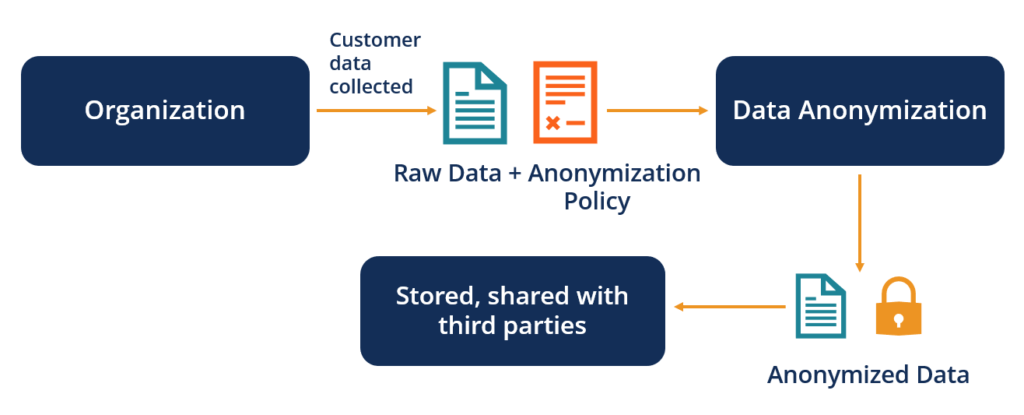
In the world of Big Data, privacy has become a major concern as vast amounts of personal information are collected and analyzed. Data anonymization techniques play a crucial role in preserving the privacy and security of individuals’ data within large datasets. These techniques involve removing or encrypting personally identifiable information to prevent individuals from being directly identified. By leveraging data anonymization methods, organizations can unlock the value of Big Data while also upholding the rights and confidentiality of individuals. In this article, we will explore the importance of data anonymization techniques in safeguarding Big Data privacy and the various approaches used to anonymize sensitive information within massive datasets.
Understanding Data Anonymization
Data anonymization refers to the process of removing or modifying personally identifiable information from a dataset. This ensures that individuals cannot be easily identified. As the volume of data generated continues to rise, implementing effective data anonymization techniques becomes crucial for Big Data privacy and compliance with regulations like GDPR and CCPA.
The Importance of Anonymization in Big Data
The exponential increase of data collection has led organizations to explore valuable insights from vast datasets. However, with this advantage comes the responsibility to protect individual privacy. Anonymization helps organizations mitigate risks associated with data breaches and maintain user trust.
Common Data Anonymization Techniques
1. Data Masking
Data masking is the process of substituting original data with fictitious data while preserving its format. This technique allows organizations to use database information without exposing sensitive details.
Example applications include testing environments, where developers require realistic data but should not access real user records.
2. K-anonymity
K-anonymity is a model that ensures each individual in a dataset cannot be distinguished from at least k others with respect to certain identifying attributes. This technique is particularly effective in datasets containing demographic information.
For instance, if a dataset includes age, gender, and ZIP code, generalizing these attributes so that at least k individuals share identical traits can help protect personal identities.
3. L-diversity
While K-anonymity provides a level of privacy, it does not account for attribute disclosure risks. L-diversity addresses this by requiring that the sensitive attribute within each equivalence class contains at least l distinct values. This ensures that background knowledge does not lead to easy identification of sensitive information.
4. T-closeness
T-closeness is an advanced model that encompasses K-anonymity and L-diversity by ensuring that the distribution of a sensitive attribute in the anonymized data is similar to the distribution of that attribute in the whole dataset. This helps mitigate the risk of attribute disclosure while providing sufficient anonymization for sensitive data.
5. Differential Privacy
Differential privacy introduces random noise to datasets to obscure individual data points while still allowing accurate aggregate analysis. This technique has gained popularity, particularly among tech giants like Google and Apple, as it allows for meaningful insights without compromising individual privacy.
For example, if a dataset contains user health records, differential privacy enables researchers to publish statistics about health trends without revealing specific information about any single person.
6. Data Aggregation
Data aggregation involves compiling individual data points into summaries or groups. This means instead of accessing detailed information about individuals, analysts work with aggregated data sets that represent larger populations, maintaining individuals’ privacy.
For example, instead of reporting the exact number of people in a specific age group within a region, a report might state that “approximately 20% of the population falls within this age range,” thus safeguarding individual identities.
7. Synthetic Data Generation
Synthetic data generation involves creating artificial datasets that mimic the statistical properties of real data without including any real personal information. By using algorithms to generate data based on real patterns, organizations can conduct experiments or analytics without risking exposure of real user data.
This technique is particularly valuable in machine learning where large datasets are essential for building reliable models.
8. Pseudonymization
Pseudonymization replaces private identifiers with fake identifiers or pseudonyms. While it offers a degree of protection, it is essential to note that pseudonymization, unlike complete anonymization, allows for the possibility of re-identification if paired with additional information.
This method is often used in conjunction with other anonymization techniques to enhance data privacy.
Challenges in Data Anonymization
- Data Utility vs. Privacy: Striking a balance between maintaining the usefulness of the data and ensuring privacy can be complex. Over-anonymizing can lead to loss of valuable insights.
- Risk of Re-identification: Advanced analytical techniques and the availability of additional data make it easier to re-identify anonymized records.
- Compliance Issues: Different regulations have varying requirements for data anonymization, making it crucial for organizations to stay informed and compliant.
- Implementation Complexity: Depending on the size and nature of the dataset, implementing anonymization can be resource-intensive and complex.
Best Practices for Effective Data Anonymization
To maximize data privacy while maintaining analytical value, consider the following best practices:
- Conduct Regular Audits: Regularly review and audit your data anonymization processes to ensure compliance and effectiveness.
- Combine Techniques: Use multiple anonymization techniques in tandem to enhance privacy without sacrificing data utility.
- Data Minimization: Only collect and retain data that is absolutely necessary for your operations.
- Stay Informed: Keep up with the evolving regulatory landscape concerning data privacy and adapt your techniques accordingly.
- Train Employees: Educate your team on the importance of data privacy and the implementation of anonymization techniques.
Conclusion
In an era where data breaches can have significant consequences, the adoption of effective data anonymization techniques is paramount for businesses seeking to protect their users’ privacy. By leveraging various methods and staying informed of best practices, organizations can achieve a beneficial balance between data utility and privacy, paving the way for a responsible big data ecosystem.
Data anonymization techniques play a crucial role in safeguarding the privacy of individuals and ensuring compliance with regulations in the realm of Big Data. By applying these techniques effectively, organizations can balance the need for data analysis with respect for privacy rights, thereby fostering trust among stakeholders and promoting ethical data practices in the ever-evolving landscape of Big Data.
Related posts:
 The Five Vs of Big Data: Volume, Velocity, Variety, Veracity, and Value
 Understanding Data Pipelines in Big Data
 What is Apache Hadoop? A Complete Guide
 Introduction to NoSQL Databases for Big Data
 Understanding HBase: How it Works in the Hadoop Ecosystem
 Natural Language Processing (NLP) with Big Data
 How Big Data is Used in Deep Learning Applications
 Sentiment Analysis with Big Data and AI
 Real-Time AI and Big Data: How It Works
 The Impact of Big Data on Financial Services and Banking
 Big Data in Smart Cities: Applications and Challenges
 Big Data and Retail: How It’s Changing the Shopping Experience
 Big Data in Agriculture: Precision Farming and Analytics
 What is Predictive Analytics in Big Data?