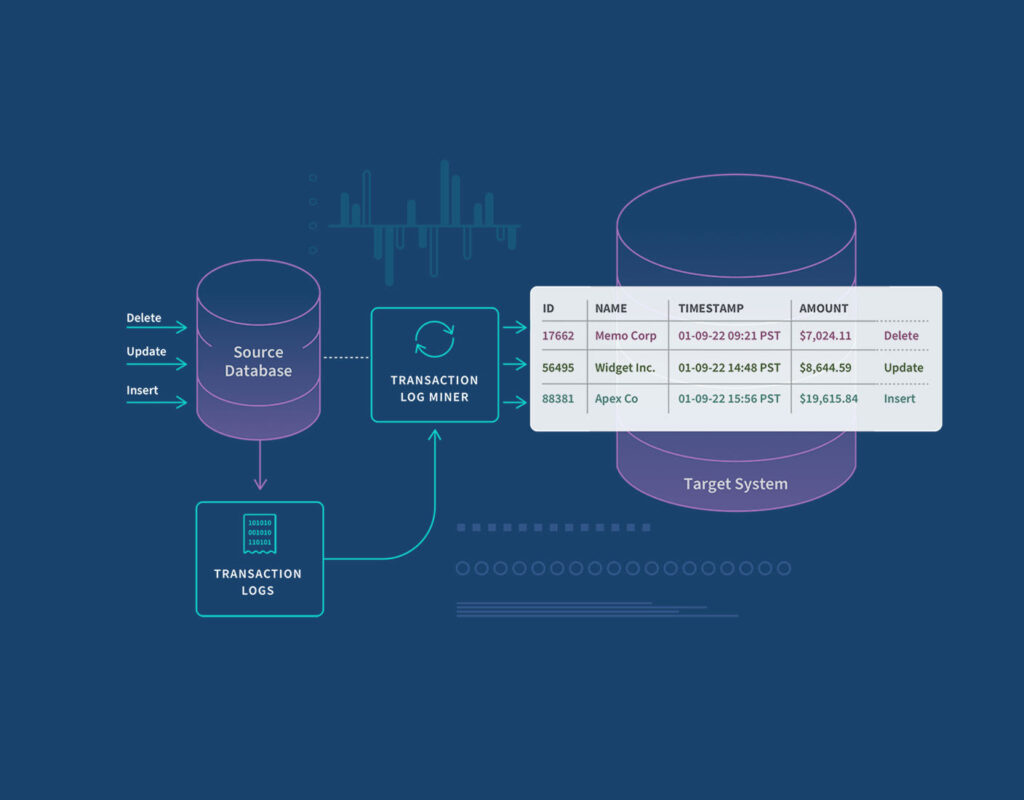
In the realm of Big Data analytics, Change Data Capture (CDC) plays a significant role in capturing and tracking real-time data changes within a database. CDC technology enables organizations to identify, process, and utilize data modifications as they occur, allowing for the continuous updating of data repositories without the need for manual intervention. This introduction will delve into the concept of CDC in Big Data, highlighting its importance, benefits, and applications in harnessing the power of real-time data for optimizing business decision-making and performance.
Change Data Capture (CDC) is a crucial component in the realm of Big Data, serving as a methodology to detect and track changes made to data in databases. Implementing CDC can significantly impact the efficiency and accuracy of data processing and analysis, especially in environments characterized by high-velocity data flows.
What is Change Data Capture (CDC)?
Change Data Capture refers to techniques that identify and capture changes in a database without having to discard or purge the original data. This process typically involves tracking insert, update, and delete operations so that those changes can be reflected in downstream systems. CDC is essential for maintaining data integrity across various data platforms.
Why is CDC Important in Big Data?
In the context of Big Data, the importance of CDC can be summarized in several key points:
- Real-Time Data Processing: CDC enables the real-time processing of data changes, which is critical for applications such as fraud detection or real-time analytics.
- Data Integration: As organizations rely on multiple data sources, CDC helps in synchronizing these disparate systems without significant performance overhead.
- Historical Data Analysis: By capturing changes over time, organizations can perform sophisticated historical analysis, providing insights into data trends and patterns.
- Minimized Resource Consumption: Instead of replicating entire datasets, CDC focuses on only the data changes, conserving bandwidth and storage.
- Error Reduction: CDC provides a more reliable method for data replication, which minimizes the risk of data inconsistency.
How Does Change Data Capture Work?
CDC can be implemented in several ways, each suited to various environments and requirements:
1. Log-Based Change Data Capture
Log-based CDC leverages the transaction logs maintained by database systems. These logs store changes in data operations, allowing CDC systems to read and interpret these entries in real-time. This method has low overhead since it does not require querying the database directly.
2. Trigger-Based Change Data Capture
In trigger-based CDC, database triggers are employed to capture changes. Whenever a change occurs to a specific table, the trigger automatically executes and records the change in a designated CDC table. Though effective, this method can introduce performance overhead, particularly in systems with high transaction volumes.
3. Polling-Based Change Data Capture
Polling involves periodically querying the database for changes. This method is less efficient than log-based or trigger-based approaches but is straightforward to implement. However, it may lead to a lag in data sync and is not ideal for real-time updates.
4. Change Data Capture using Cloud Services
With the advent of cloud computing, many cloud services now offer built-in CDC capabilities to streamline data integration. These services often come with scalable architectures and can interact seamlessly with various data sources.
Challenges in Implementing Change Data Capture
While CDC presents numerous benefits, there are challenges that organizations may encounter:
1. Data Quality
Ensuring that captured changes are of high quality is essential. Poor data quality can affect analytics and decision-making processes.
2. Latency
Depending on the implemented method, latency can become a concern. For instance, polling-based methods can introduce significant delays in data capture.
3. Schema Changes
When the schema of a database changes, existing CDC implementations may require revisions or reconfigurations, presenting additional complexity.
4. Security and Compliance
Ensuring that data capture complies with security regulations and policies is crucial. Organizations must enforce strict access control to protect sensitive data.
Best Practices for Implementing Change Data Capture
To effectively implement CDC in a Big Data environment, organizations can follow these best practices:
1. Choose the Right CDC Method
Evaluate and select the most suitable CDC method based on your organization’s specific needs, workload, and target architecture.
2. Maintain a Clear Data Dictionary
A well-documented data dictionary can assist in understanding what data is captured and how it flows through systems, ensuring better data governance.
3. Monitor and Optimize Performance
Implement monitoring tools to keep track of CDC performance and optimize it continuously to minimize overhead and reduce latency.
4. Ensure Compliance and Security
Adhere to best practices for data security, ensuring that sensitive data captured through CDC is appropriately protected.
5. Test in a Staging Environment
Before full-scale implementation, test the CDC process in a staging environment to identify potential issues without impacting production systems.
Popular Tools for Change Data Capture
Several data integration tools and platforms have incorporated CDC features, facilitating its adoption in the Big Data landscape:
1. Apache Kafka
Apache Kafka is a popular open-source stream processing platform that includes Kafka Connect, an integration framework that can leverage CDC.
2. AWS Database Migration Service
AWS DMS supports ongoing replication of data using CDC, making it easier for organizations to migrate data to and from various data stores.
3. Debezium
Debezium is an open-source CDC platform that works in conjunction with Apache Kafka, allowing real-time streaming of changes from various databases.
4. Microsoft SQL Server
SQL Server includes built-in support for CDC, providing tools to track changes and synchronize data with minimal effort.
Use Cases for Change Data Capture in Big Data
The versatility of CDC lends itself to various use cases, including:
1. Data Warehousing
Reducing the load on data warehouses by allowing only the changed data to be processed can enhance performance and reduce costs.
2. Real-Time Analytics
Organizations can run real-time analytics on data streams, gaining immediate insights that can drive business decisions.
3. Data Replication
CDC simplifies data replication between different databases or environments, ensuring consistency across systems.
4. Change Tracking for Applications
Applications that require real-time updates can benefit from CDC by integrating with data layers that use CDC to push changes instantly.
Change Data Capture is an integral part of Big Data processing, offering a reliable and efficient way to manage data changes. Its implementation can enhance decision-making processes and improve overall data quality across systems.
Change Data Capture (CDC) is a crucial technique in Big Data that enables real-time monitoring and synchronization of data changes across various sources. By capturing and processing only changed data, CDC minimizes processing overhead while providing up-to-date information for analytics and decision-making. As organizations continue to leverage Big Data for insights and innovations, CDC proves to be instrumental in maintaining data integrity and consistency in the ever-evolving landscape of data processing.
Related posts:
 Understanding Data Pipelines in Big Data
 What is Apache Hadoop? A Complete Guide
 Introduction to NoSQL Databases for Big Data
 Understanding HBase: How it Works in the Hadoop Ecosystem
 Natural Language Processing (NLP) with Big Data
 How Big Data is Used in Deep Learning Applications
 Sentiment Analysis with Big Data and AI
 Real-Time AI and Big Data: How It Works
 The Impact of Big Data on Financial Services and Banking
 Big Data in Smart Cities: Applications and Challenges
 Big Data and Retail: How It’s Changing the Shopping Experience
 Big Data in Agriculture: Precision Farming and Analytics
 What is Predictive Analytics in Big Data?
 Data Science vs. Big Data Analytics: Key Differences