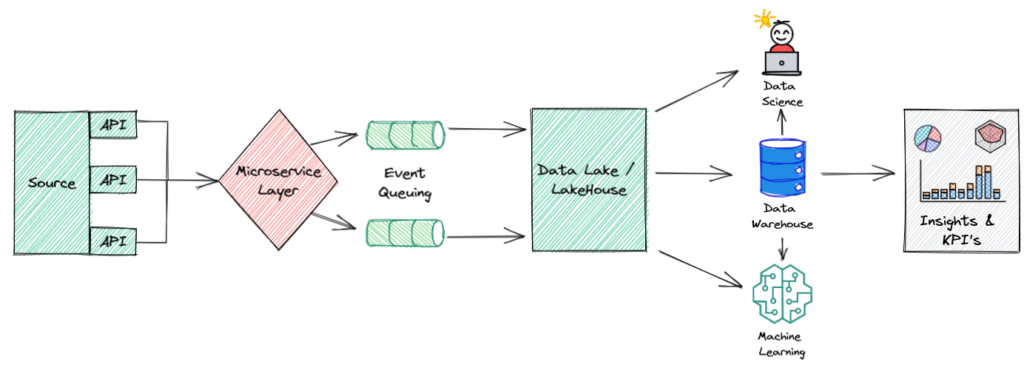
Event-Driven Architecture (EDA) plays a crucial role in the world of Big Data systems by providing the necessary framework to handle and process vast amounts of data in real-time. In essence, EDA is a paradigm that emphasizes the generation, detection, processing, and reaction to events that occur within a system in a timely manner. Within the realm of Big Data, where massive volumes of data are constantly being generated and updated, an Event-Driven Architecture ensures that data processing and analysis can happen continuously and efficiently. This introduction sets the stage for exploring the key aspects of how EDA enhances Big Data systems, enabling organizations to derive actionable insights and make data-driven decisions with agility and precision.
Understanding Event-Driven Architecture
Event-Driven Architecture (EDA) is a software design paradigm that emphasizes the production, detection, consumption, and reaction to events. In this architecture, the flow of data is driven by events — changes in state that can occur in real-time or near real-time. This architecture is particularly effective in Big Data systems, where rapid data acquisition and processing are crucial to derive meaningful insights and make informed decisions.
Key Components of Event-Driven Architecture
EDA consists of several essential components:
- Event Producers: These are components that generate events based on changes in state, such as user actions, system triggers, or sensor readings.
- Event Channels: These mechanisms transport events from producers to consumers, often utilizing messaging systems like Apache Kafka or RabbitMQ.
- Event Consumers: Components that process events, executing relevant business logic, transformations, or aggregations.
- Event Store: A repository that archives events for future reference, which can be useful for auditing and replay processes.
Benefits of EDA in Big Data Systems
Implementing an event-driven architecture in Big Data systems provides numerous advantages, including:
1. Real-Time Processing
One of the most significant benefits of EDA is its ability to support real-time processing. Traditional batch processing methods are often inadequate for many scenarios. With EDA, data is processed as events occur, allowing for immediate insight generation and quicker decision-making. Integration with tools such as Apache Flink or Apache Spark Streaming enhances this capability, providing powerful real-time analytics.
2. Scalability
Big Data systems must be scalable to manage fluctuating workloads and extensive data volumes. EDA allows systems to scale horizontally easily by adding more event producers or consumers as needed. This flexibility makes it possible to handle massive spikes in event traffic and ensures continuity in data processing.
3. Responsiveness
With EDA, systems react to events in a timely manner, improving user experience and operational efficiency. For instance, in e-commerce, customer actions can trigger immediate processes such as stock updates, order confirmations, or personalized recommendations.
4. Loose Coupling
Events facilitate a loose coupling between components within a system. This means individual components can evolve independently without worrying about the impacts on other parts of the system. For example, the introduction of new event consumers can occur without affecting the event producers, allowing for more agile development and deployment cycles.
5. Decoupling of Data Processing
In traditional data architectures, data producers and consumers are often tightly integrated. Event-Driven Architecture decouples these processes, allowing for greater flexibility in how data is processed and consumed. This decoupling enables systems to use multiple technologies and languages, as long as they can communicate via events.
Challenges of Event-Driven Architecture
While the benefits are compelling, deploying an EDA in Big Data systems comes with its challenges:
1. Complex Event Management
Managing events in an event-driven system can become complex. As the volume of events increases, it may lead to difficulties in processing or tracking events, especially with a high degree of concurrency. Appropriate strategies, like event filtering and deduplication, need to be in place.
2. Event Schema Evolution
As applications evolve, the schema of the events generated may change. Handling schema evolution without disrupting the current system or data integrity can be challenging. Tools like Apache Avro or Protobuf can help manage these changes while ensuring compatibility.
3. Monitoring and Debugging
Event-driven systems can be harder to monitor and debug, due to their asynchronous nature. It is essential to implement comprehensive logging and monitoring solutions, such as distributed tracing, to gain visibility into event flows across the system.
Implementing EDA in Big Data Systems
To successfully implement EDA in a Big Data system, follow these steps:
1. Identify Event Sources
First, identify the sources of events within your system. This could include user interactions, external APIs, data ingestion processes, and IoT devices. Understanding these sources is imperative to building an effective architecture.
2. Choose Messaging Technology
Selecting the right messaging technology is vital for transporting events. Popular choices include:
- Apache Kafka: A distributed streaming platform that is widely used for building real-time data pipelines and streaming applications.
- RabbitMQ: A message broker that facilitates the exchange of messages with effective routing capabilities.
- Amazon Kinesis: A cloud-based service that processes and analyzes streaming data in real-time.
3. Design the Event Schema
Designing a robust event schema is crucial to ensure data consistency and ease of processing. Consider utilizing formats like JSON, Avro, or Protobuf for defining and serializing events.
4. Build Event Consumers
Develop event consumers tailored to your business logic. These consumers will process the incoming events and generate the necessary actions or insights. Consider employing microservices architecture to enhance modularity and maintainability.
5. Develop an Event Store Strategy
Strategically design how events will be stored and accessed. Event stores like EventStore or using cloud solutions can provide scalable storage options for your events.
Use Cases of EDA in Big Data Systems
Several industries have successfully implemented EDA in their Big Data systems, achieving notable outcomes:
1. E-Commerce
In e-commerce, businesses utilize EDA to track user behavior in real-time, adjusting marketing strategies and inventory levels dynamically based on consumer engagement patterns.
2. Financial Services
The financial sector applies EDA to monitor transactions for anomalies and fraud detection, enabling immediate alerts and interventions, thereby protecting consumers and assets.
3. IoT Applications
In IoT, EDA facilitates real-time analytics by processing streams of data from devices, making it easier to monitor systems, predict maintenance needs, and optimize operations.
4. Healthcare
In healthcare, integrating EDA helps in managing patient data and medical devices efficiently, allowing for timely alerts and data updates that can improve patient outcomes.
The Future of Event-Driven Architecture in Big Data
As Big Data continues to evolve and expand, the significance of Event-Driven Architecture is expected to rise. The demand for real-time data processing and analytics is becoming more pronounced as organizations seek to remain competitive and responsive. Innovations in technologies like serverless computing, streaming analytics, and machine learning will further enhance the capabilities of EDA, enabling businesses to extract more value from their data than ever before.
Event-Driven Architecture plays a crucial role in Big Data systems by enabling real-time data processing, scalability, and agility. By leveraging event-driven approaches, organizations can effectively manage and analyze vast volumes of data to drive insights and enhance decision-making processes in today’s data-driven landscape.
Related posts:
 The Five Vs of Big Data: Volume, Velocity, Variety, Veracity, and Value
 What is a Data Lake? Definition, Uses, and Benefits
 Introduction to Distributed Computing in Big Data
 Understanding Data Pipelines in Big Data
 Data Ingestion Techniques for Big Data Processing
 What is Apache Hadoop? A Complete Guide
 Understanding Apache Spark: Features and Use Cases
 Introduction to NoSQL Databases for Big Data
 The Role of MongoDB in Big Data Analytics
 Understanding HBase: How it Works in the Hadoop Ecosystem
 How Elasticsearch is Used in Big Data Applications
 The Intersection of Big Data and Artificial Intelligence
 How Big Data Powers Machine Learning Models
 Natural Language Processing (NLP) with Big Data