Hierarchical clustering is a powerful technique used to group similar data points together based on their characteristics. When working with large datasets in the realm of Big Data, implementing hierarchical clustering poses unique challenges and opportunities. In this article, we will explore the key considerations and strategies to effectively apply hierarchical clustering on large datasets, leveraging the scalability and efficiency of Big Data technologies. By understanding how to navigate the complexities of large datasets, we can unlock valuable insights and patterns that can drive informed decision-making and enhance data-driven applications.
Hierarchical clustering is an important technique in Big Data analytics that offers insights into the structure of large datasets by grouping similar items together. As a process of clustering, it allows organizations to uncover patterns and relationships without prior knowledge about the number of clusters. In this article, we explore how to implement hierarchical clustering on large datasets efficiently.
Understanding Hierarchical Clustering
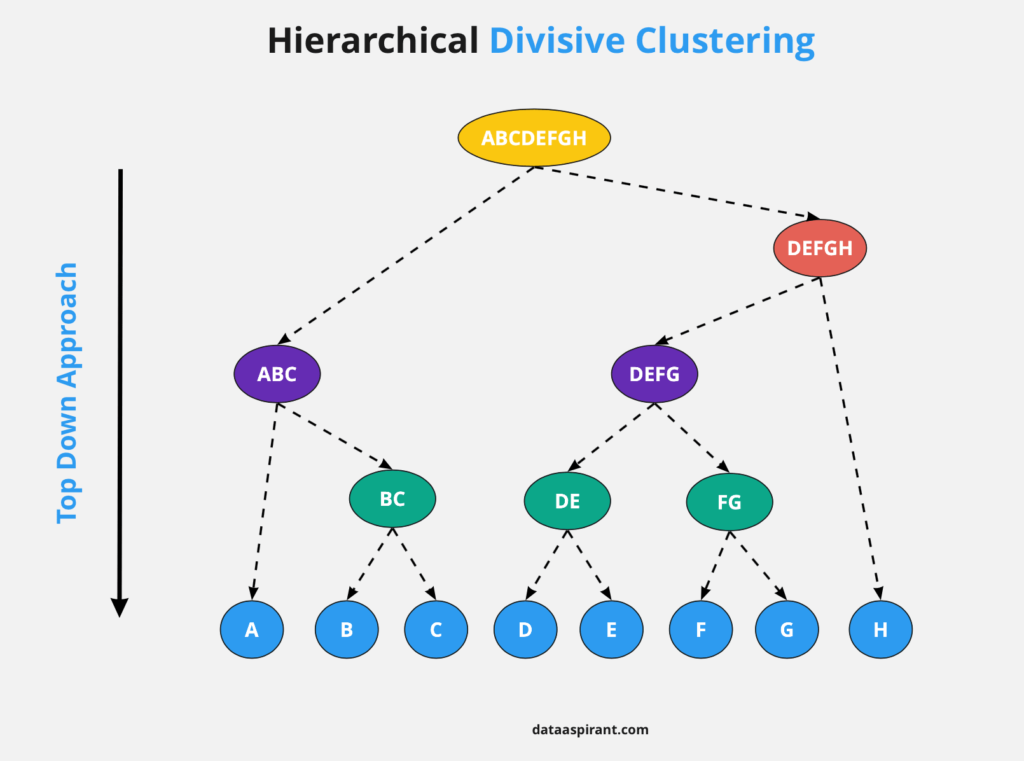
Hierarchical clustering builds a hierarchy of clusters either in a bottom-up (agglomerative) or top-down (divisive) approach. The agglomerative approach starts with individual elements and merges them into larger clusters, while the divisive strategy splits a large cluster into smaller components. This article focuses primarily on the agglomerative method due to its popularity in clustering large datasets.
Key Steps to Implement Hierarchical Clustering
1. Data Preparation
The first step in implementing hierarchical clustering is to prepare your data. The quality and structure of your dataset significantly impact the clustering results. Follow these guidelines:
- Data Cleaning: Remove any missing or erroneous values to ensure accurate cluster formation.
- Normalization: Scale your features to treat them equally during the clustering process. Common normalization techniques include Min-Max scaling and Standardization.
- Dimensionality Reduction: Utilize techniques like Principal Component Analysis (PCA) or t-SNE to reduce the dimensionality of your data. This is especially useful for large datasets to improve clustering efficiency.
2. Choose a Distance Metric
The choice of distance metric is crucial in determining how similarity is computed between data points. Common distance measures include:
- Euclidean Distance: This is the most commonly used distance metric, especially when data is uniformly distributed.
- Manhattan Distance: More suitable for high-dimensional data, measuring distance based on absolute differences between coordinates.
- Cosine Similarity: Ideal for text data and when dealing with high-dimensional vectors, such as TF-IDF scores.
3. Construct the Dendrogram
A dendrogram is a tree-like diagram that shows the arrangement of clusters based on distance. In a large dataset, plotting the entire dendrogram can be cumbersome. Here’s how to handle it effectively:
- Utilize clustering libraries such as Scikit-learn in Python or R’s hclust function that can automatically handle large datasets.
- Consider visualizing only a subset of the dendrogram to gain insights without overwhelming your analysis.
4. Agglomerative Clustering Implementation
Once you have prepared the data and understood the distance metrics, you can implement agglomerative clustering. Here’s a step-by-step guide using Python with Scikit-learn:
import numpy as np
import pandas as pd
import matplotlib.pyplot as plt
from scipy.cluster.hierarchy import dendrogram, linkage
from sklearn.cluster import AgglomerativeClustering

# Load your dataset
data = pd.read_csv('your_large_dataset.csv')

# Data Cleaning and Normalization
data.fillna(data.mean(), inplace=True)
from sklearn.preprocessing import StandardScaler
scaler = StandardScaler()
data_scaled = scaler.fit_transform(data)

# Choose method for linkage and distance metric
linked = linkage(data_scaled, method='ward')

# Create Dendrogram
plt.figure(figsize=(10, 7))
dendrogram(linked, orientation='top', distance_sort='descending', show_leaf_counts=True)
plt.show()

# Implement Agglomerative Clustering
agg_clustering = AgglomerativeClustering(n_clusters=5)
data['Cluster'] = agg_clustering.fit_predict(data_scaled)
Managing Large Datasets
When working with large datasets, efficiency becomes paramount. Here are several strategies to manage data size and enhance performance:
- Data Sampling: Consider using a representative sample of your data for the initial clustering to gauge results and refine your approach.
- Use of Libraries: Libraries such as Dask or Vaex allow big data manipulation and can work with larger-than-memory datasets seamlessly.
- Parallel Processing: Leverage multi-threading or distributed computing platforms like Apache Spark to speed up the clustering process.
Evaluating the Clustering Results
Clustering alone does not guarantee quality insights. It is imperative to evaluate your clustering results using specific metrics such as:
- Silhouette Score: A measure of how close each sample in one cluster is to the samples of the neighboring clusters.
- Davies-Bouldin Index: The ratio of within-cluster scatter to between-cluster separation, where lower values indicate better clustering.
- Cluster Size Distribution: Ensure clusters are balanced; very large or small clusters may warrant investigation.
Challenges and Considerations
While hierarchical clustering is powerful, it has its challenges, especially with large datasets:
- Computational Complexity: Hierarchical clustering can be computationally intensive (O(n^3)), making it infeasible for extremely large datasets.
- Memory Consumption: Storing all distance measurements can require significant memory resources. Consider strategies to mitigate this, like approximating the distance matrix.
- Choice of Clustering Depth: Determine the appropriate level of clustering. Too many clusters can lead to noise, while too few can oversimplify data.
Alternative Methods
If hierarchical clustering proves to be inefficient for your large-scale datasets, consider alternative clustering methodologies:
- K-Means Clustering: Efficient for large datasets, though it requires prior knowledge of the number of clusters.
- DBSCAN: Suitable for identifying clusters of varying shapes and sizes, especially useful with noise-heavy data.
- Gaussian Mixture Models: Probabilistic models that offer flexible cluster shapes, beneficial for complex datasets.
Implementing Hierarchical Clustering in Different Programming Environments
Hierarchical clustering can be implemented in various programming environments. Here are a few examples:
1. R
R offers robust packages like stats and fastcluster for hierarchical clustering:
library(stats)
data <- read.csv('your_large_dataset.csv')
data_scaled <- scale(data)

# Create a dendrogram
hc <- hclust(dist(data_scaled), method = "ward.D2")
plot(hc)

# Cut the dendrogram into k clusters
clusters <- cutree(hc, k = 5)
data$Cluster <- clusters
2. Apache Spark
For massive datasets, Apache Spark’s MLlib clustering toll provides a scalable way to conduct hierarchical clustering:
from pyspark.ml.clustering import BisectingKMeans
from pyspark.sql import SparkSession

spark = SparkSession.builder.appName("Hierarchical Clustering").getOrCreate()
data = spark.read.csv("your_large_dataset.csv", header=True, inferSchema=True)

# Variable transformations and preprocessing can be performed here
bkm = BisectingKMeans().setK(5).setSeed(1)
model = bkm.fit(data)

# Get the cluster predictions
predictions = model.transform(data)
Final Thoughts
Implementing hierarchical clustering on large datasets is a multifaceted endeavor requiring meticulous preparation, selection of methods, and evaluation of results. By leveraging appropriate tools and methodologies, analysts can extract invaluable insights from their data, ultimately driving informed decision-making in businesses.
Implementing hierarchical clustering on large datasets in the context of Big Data requires careful consideration of scalability, computational efficiency, and optimal clustering techniques. By leveraging parallel processing, distributed computing frameworks, and advanced algorithms, organizations can effectively analyze and extract meaningful insights from massive datasets while managing the complexities inherent in Big Data analytics.
Related posts:
 The Five Vs of Big Data: Volume, Velocity, Variety, Veracity, and Value
 Understanding Data Pipelines in Big Data
 What is Apache Hadoop? A Complete Guide
 Introduction to NoSQL Databases for Big Data
 Understanding HBase: How it Works in the Hadoop Ecosystem
 Natural Language Processing (NLP) with Big Data
 How Big Data is Used in Deep Learning Applications
 Sentiment Analysis with Big Data and AI
 Real-Time AI and Big Data: How It Works
 The Impact of Big Data on Financial Services and Banking
 Big Data in Smart Cities: Applications and Challenges
 Big Data and Retail: How It’s Changing the Shopping Experience
 Big Data in Agriculture: Precision Farming and Analytics
 What is Predictive Analytics in Big Data?