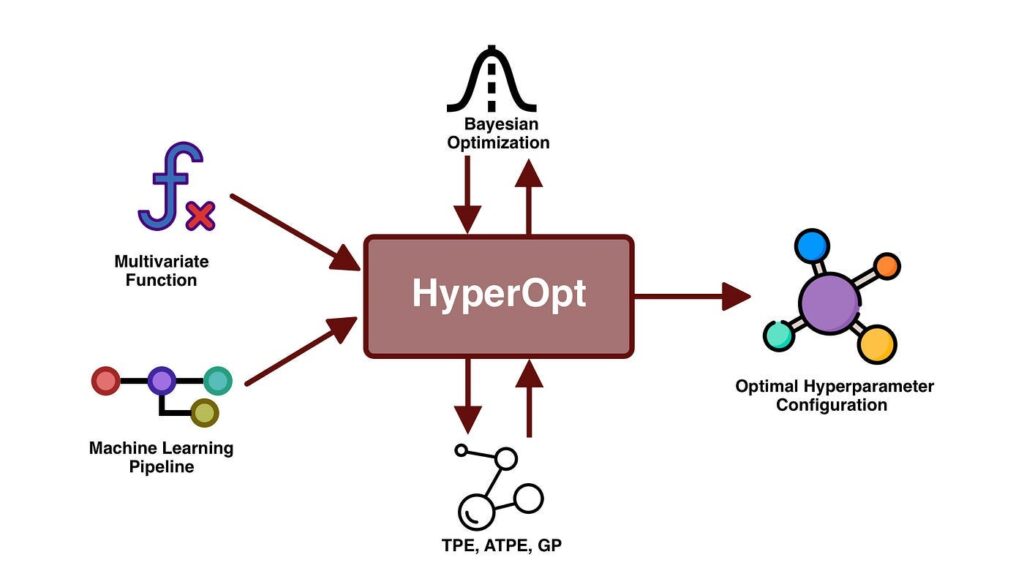
Bayesian optimization plays a crucial role in fine-tuning machine learning models that handle big data. The enormous scale and complexity of big data pose challenges for traditional hyperparameter tuning techniques. In this context, Bayesian optimization provides an efficient and effective method for optimizing model performance by intelligently navigating the hyperparameter space. By leveraging probabilistic models and statistical reasoning, Bayesian optimization helps data scientists identify the best hyperparameters for their big data machine learning models, ultimately improving accuracy, efficiency, and scalability. This article will delve deeper into the significance of Bayesian optimization in fine-tuning big data ML models, exploring its benefits and real-world applications within the realm of big data analytics.
In the realm of Big Data, machine learning (ML) models are often complex and require careful tuning of hyperparameters. Bayesian Optimization has emerged as a powerful tool for this purpose, offering a systematic method that enhances model performance while minimizing resource expenditure. This article delves into the principles of Bayesian Optimization and its critical role in the fine-tuning of Big Data ML models.
Understanding Bayesian Optimization
Bayesian Optimization is a probabilistic model-based optimization technique widely used for optimizing black-box functions that are expensive to evaluate. Unlike traditional optimization methods, Bayesian Optimization builds a surrogate model that approximates the unknown function based on prior evaluations. This allows it to intelligently explore the search space, focusing on areas that are likely to yield better results.
Key Components of Bayesian Optimization
There are several essential components that make up the Bayesian Optimization process:
1. Surrogate Model
The surrogate model is typically a Gaussian Process (GP) that provides a probabilistic representation of the function being optimized. This model estimates the mean and uncertainty of the function, enabling the optimization process to balance exploration and exploitation effectively.
2. Acquisition Function
The acquisition function is a crucial element that guides where to sample next in the parameter space. Common acquisition functions include:
- Expected Improvement (EI): Focuses on areas that offer the potential for improvement over the current best observation.
- Probability of Improvement (PI): Evaluates the likelihood of obtaining a result exceeding the current best.
- Upper Confidence Bound (UCB): Balances exploration of uncertain areas against exploitation of known good areas.
3. Updating the Model
After each iteration, the surrogate model is updated with the new results, refining its predictions based on the latest data. This continuous learning process is what makes Bayesian Optimization particularly suitable for hyperparameter tuning in Big Data settings.
The Need for Efficient Hyperparameter Tuning
Hyperparameter tuning is an essential step in the ML pipeline, determining the model’s complexity and its capacity to generalize. For large datasets, this process can be computationally prohibitive, as an exhaustive grid search or random search is often infeasible. Here, Bayesian Optimization shines by significantly reducing the number of evaluations needed to identify the optimal hyperparameter settings.
Challenges in Hyperparameter Tuning for Big Data
Tuning ML models in the context of Big Data presents unique challenges:
- Large Search Spaces: ML models, especially complex ones like neural networks, can have vast hyperparameter spaces requiring exploration.
- Computational Cost: Each evaluation of the model can take a long time to compute, particularly with extensive datasets.
- Resource Limitations: Often, organizations have limited computational resources, making it vital to optimize efficiently.
How Bayesian Optimization Addresses These Challenges
By utilizing Bayesian Optimization, practitioners can tackle the limitations faced during hyperparameter tuning:
1. Reduced Evaluations
Bayesian Optimization’s ability to build a surrogate model means fewer evaluations are necessary to converge on an optimal set of hyperparameters. This is particularly beneficial in the Big Data context, as it alleviates the strain on resources while still providing effective model tuning.
2. Adaptivity to Model Performance
Since Bayesian Optimization continuously updates its model with the most recent evaluations, it adapts quickly to how well different hyperparameter choices are performing. This allows for a more dynamic exploration of the parameter space, where the algorithm can hone in on promising candidates more effectively.
3. Parallelization Capabilities
Many implementations of Bayesian Optimization allow for parallel evaluations of different configurations, enabling substantial time savings. This feature is valuable for Big Data applications, where multiple hyperparameters can be tested simultaneously across different computational nodes.
Implementing Bayesian Optimization in Big Data ML Models
To implement Bayesian Optimization effectively, practitioners can follow key steps:
Step 1: Define the Objective Function
The objective function represents a model’s performance metric, such as accuracy, F1 score, or other relevant metrics, based on different hyperparameter settings. Properly defining this function is crucial for the optimization process.
Step 2: Choose a Surrogate Model
While Gaussian Processes are commonly used, other models such as Random Forests or Bayesian Neural Networks can also be utilized depending on the problem context and computational resources.
Step 3: Select an Acquisition Function
Depending on the specific optimization goal, practitioners must choose the most appropriate acquisition function, balancing exploration of the search space against exploitation of known good areas.
Step 4: Start Optimization
Initiate the optimization process, iterating through evaluations and updates of the surrogate model, sampling new points according to the chosen acquisition function. This continues until a stopping criterion is met, such as reaching a temporal limit or a maximum number of evaluations.
Tools and Libraries for Bayesian Optimization
Several libraries and tools have been developed to facilitate Bayesian Optimization, making it more accessible for practitioners:
- Scikit-Optimize: A simple and efficient library that integrates with the Scikit-learn framework for seamless optimization of ML models.
- GPyOpt: A powerful library built on top of GPy for easily implementing Bayesian optimization workflows.
- Spearmint: An advanced Bayesian Optimization library tailored for more complex models and large datasets.
Real-World Applications of Bayesian Optimization in Big Data
The advantages of Bayesian Optimization have led to its adoption in various industries. Here are a few examples of its application in Big Data contexts:
1. Finance
In the finance sector, Bayesian Optimization is used for optimizing trading strategies and risk assessments. By tuning models that predict stock movements, firms can gain competitive advantages while handling vast historical datasets efficiently.
2. Healthcare
In healthcare, Bayesian Optimization enhances predictive analytics related to patient outcomes based on large datasets. The optimization of machine learning models accelerates research initiatives, allowing deeper insights into critical health metrics.
3. Marketing
Marketing teams leverage Bayesian Optimization to fine-tune recommendation systems and customer segmentation models. By optimizing advertising strategies based on user interactions in massive datasets, businesses can improve return on investment (ROI).
4. Manufacturing
In manufacturing, Bayesian Optimization can help in tuning predictive maintenance models, ensuring machinery operates at optimal levels and minimizing downtime, thus improving operational efficiency.
Conclusion: The Future of Hyperparameter Optimization
While this article does not include a formal conclusion, it is clear that Bayesian Optimization plays a significant role in the landscape of Big Data machine learning model fine-tuning. By efficiently identifying optimal hyperparameters, it enhances model performance while addressing the computational limitations inherent in large datasets. As ML continues to evolve, Bayesian Optimization will likely remain a cornerstone technique, driving innovation and facilitating advanced analytics across various industries.
Bayesian optimization plays a crucial role in fine-tuning ML models for Big Data applications by efficiently navigating the high-dimensional parameter space. Its ability to balance exploration and exploitation helps in achieving optimal model performance with reduced computational cost. Embracing Bayesian optimization in the Big Data landscape can lead to improved efficiency and effectiveness in developing ML models for complex data analysis tasks.
Related posts:
 The Five Vs of Big Data: Volume, Velocity, Variety, Veracity, and Value
 What is a Data Lake? Definition, Uses, and Benefits
 Introduction to Distributed Computing in Big Data
 Understanding Data Pipelines in Big Data
 Data Ingestion Techniques for Big Data Processing
 What is Apache Hadoop? A Complete Guide
 Understanding Apache Spark: Features and Use Cases
 Introduction to NoSQL Databases for Big Data
 The Role of MongoDB in Big Data Analytics
 Understanding HBase: How it Works in the Hadoop Ecosystem
 How Elasticsearch is Used in Big Data Applications
 The Intersection of Big Data and Artificial Intelligence
 How Big Data Powers Machine Learning Models
 Natural Language Processing (NLP) with Big Data