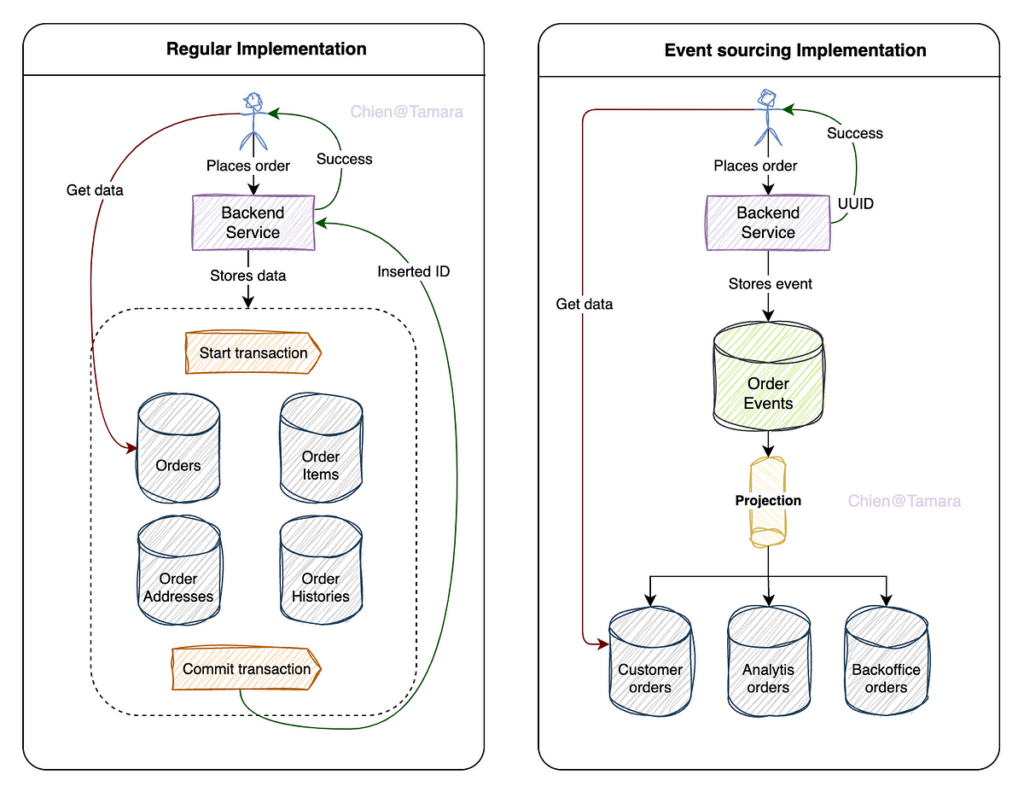
Event sourcing is a crucial concept in Big Data architecture that revolutionizes the way data is managed and processed. By capturing every state change as a discrete event, event sourcing ensures a complete and accurate historical record of data evolution. This approach is particularly beneficial in Big Data environments where massive volumes of data are generated and processed continuously. Event sourcing allows for not only real-time analysis but also the ability to reconstruct data history, making it an invaluable tool for ensuring data integrity, traceability, and scalability in Big Data systems.
Understanding Event Sourcing
Event sourcing is a vital architectural pattern in which state changes in an application are stored as a sequence of events. Unlike traditional data architectures that save only the current state, event sourcing captures every change as a distinct event. This provides a comprehensive history of the application’s data, offering significant advantages in the realm of Big Data architecture.
How Event Sourcing Works
In the event sourcing approach, every transition in state is saved as an event, which is then appended to an event store. This event store functions as the main data repository. The application can reconstruct the current state by replaying events from the event store in the exact order they occurred. This methodology allows systems to handle changes more flexibly and reliably.
Advantages of Event Sourcing in Big Data
The integration of event sourcing within a Big Data architecture presents several advantages:
1. Auditability and Traceability
By maintaining a full history of changes, event sourcing enables unparalleled auditability. Organizations can track how data changes over time, which is crucial for compliance in regulated industries. If discrepancies arise, businesses can identify the source of an error by examining the event log.
2. Scalability and Performance
Event sourcing allows for high levels of scalability in Big Data environments. As applications expand, they can handle a vast number of events without degrading performance. This is because only the relevant events need to be processed for retrieving current states, making the system both efficient and responsive under load.
3. Flexibility and Adaptability
With event sourcing, businesses can evolve their data models without needing to perform burdensome migrations or structural changes in the database. Since events represent each transaction, developers can easily introduce new features or adapt existing processes by simply adding new event types, making the system much more flexible.
4. Simplified Debugging and Error Recovery
Debugging applications built on event sourcing becomes significantly easier. Instead of being limited to the current state, developers can examine past events to understand what happened leading to a problem. In case of failure, reconstructing the state or rolling back to a previously known good state can be efficiently carried out.
5. Improved Collaboration and Domain-Driven Design
Event sourcing aligns well with domain-driven design (DDD), enabling teams to build bounded contexts with clearly defined models. This facilitates better collaboration among developers, business analysts, and stakeholders, ensuring that everyone shares a clear understanding of the events that drive the business processes.
Considerations for Implementing Event Sourcing
While the benefits of event sourcing are substantial, there are several considerations to keep in mind:
1. Complexity
Event sourcing introduces additional complexity into the architecture. Developers must account not only for the current state of the application but also manage the event store and ensure that events are correctly handled, which may require additional patterns like event versioning and event replaying.
2. Storage Management
As the volume of events grows within a Big Data system, efficient storage management becomes essential. Proper strategies for archiving, compressing, and partitioning event data must be developed to prevent performance degradation and ensure scalability.
3. Mailbox and Event Handling
In highly asynchronous systems, managing event order becomes crucial. Developers need to ensure that events are processed in the order they were originally created, which could pose challenges in distributed architectures.
Event Sourcing and Big Data Technologies
Various Big Data technologies seamlessly integrate with event sourcing:
1. Apache Kafka
Apache Kafka, a leading distributed event streaming platform, serves as an exemplary foundation for event sourcing. Kafka provides high throughput, persistent storage, and fault tolerance, allowing it to seamlessly handle massive data streams and represent each change as an event.
2. NoSQL Databases
NoSQL databases like Cassandra and MongoDB are ideal for event stores. Their eventual consistency models support the storage of events while ensuring high availability and partition tolerance.
3. Stream Processing Engines
Tools like Apache Flink, Apex, or Apache Storm can process business events in real-time, enriching the event sourcing architecture by allowing on-the-fly transformations and analytics.
Best Practices for Event Sourcing in Big Data Architecture
To successfully implement event sourcing, consider the following best practices:
1. Create a Clear Event Model
Design a clear and comprehensive event model that captures all essential aspects of state changes within the application. Ensure that events are descriptive enough to be understood without requiring deep context into the system.
2. Ensure Idempotency in Event Handling
Design event handlers to be idempotent to withstand retries and duplicate event processing without producing erroneous results. This is especially crucial in distributed systems where network reliability must be accounted for.
3. Utilize Event Versioning
As business processes evolve, keep backward compatibility of events through event versioning. This allows new applications to consume older events without breaking functionality.
4. Implement Monitoring and Notification Mechanisms
Employ monitoring tools to track application performance, event processing times, and errors. Real-time alerts can help maintain system health and improve response times to potential issues.
5. Periodic Snapshots
Consider taking periodic snapshots of the current state to facilitate faster reads and reduce the overhead of replaying large numbers of events. These snapshots can serve as a base state for calculating deltas of events.
Conclusion and Future Trends
As the field of Big Data continues to evolve, the role of event sourcing is anticipated to grow even more prominent. New technologies and methodologies that focus on real-time analytics and rapid data processing are driving the need for robust data architectures that prioritize event-driven approaches. By embracing event sourcing, organizations will prepare themselves for a more agile, responsive, and data-centric future.
Event sourcing plays a crucial role in Big Data architecture by providing a robust and efficient way to capture and store real-time data changes. By leveraging event sourcing, organizations can maintain a complete audit trail of data changes, enable faster data processing, and enhance scalability in their Big Data systems. This approach not only ensures data integrity and traceability but also empowers organizations to derive valuable insights from the ever-growing volume of data. Ultimately, integrating event sourcing into Big Data architecture is essential for driving innovation, making informed decisions, and achieving competitive advantages in the data-driven world.
Related posts:
 The Future of Digital Twins in Large-Scale Big Data Simulations
 The Impact of Federated Analytics on Big Data Privacy
 The Role of Causal AI in Understanding Big Data Relationships
 How to Perform Large-Scale Time Series Forecasting with Big Data
 The Role of AutoML in Scaling Big Data Model Deployment
 How to Perform Real-Time Outlier Detection in Big Data Pipelines
 The Future of AI-Powered Data Wrangling for Big Data Scientists
 The Role of Synthetic Tabular Data Generation in Big Data Training Sets
 The Future of Hypergraph-Based Machine Learning in Big Data Applications
 The Impact of Transfer Learning on Large-Scale AI Models
 How to Use Apache SeaTunnel for ETL in Big Data Pipelines
 The Role of AI in Automated Feature Selection for Big Data Models
 The Future of Scalable AI-Driven Big Data Pipelines
 How to Perform Online Data Augmentation for Real-Time AI Applications