In the realm of Big Data, personalization has become a crucial strategy for businesses aiming to enhance customer experiences and drive engagement. Contextual bandits, a machine learning technique well-suited for dynamic decision-making in real-time scenarios, play a pivotal role in enabling effective personalization at scale. By leveraging Big Data insights, contextual bandits empower organizations to deliver tailored content, recommendations, and experiences to individual users based on their preferences and behavior. This combination of Big Data and contextual bandits has the potential to transform how businesses interact with their customers, leading to improved outcomes and increased satisfaction.
In the rapidly evolving landscape of big data, personalization has emerged as a critical element for businesses seeking to enhance user engagement and satisfaction. Among various algorithms employed for personalization, contextual bandits have gained significant attention. This article delves into the mechanics of contextual bandits and their indispensable role in big data-driven personalization strategies.
Understanding Contextual Bandits
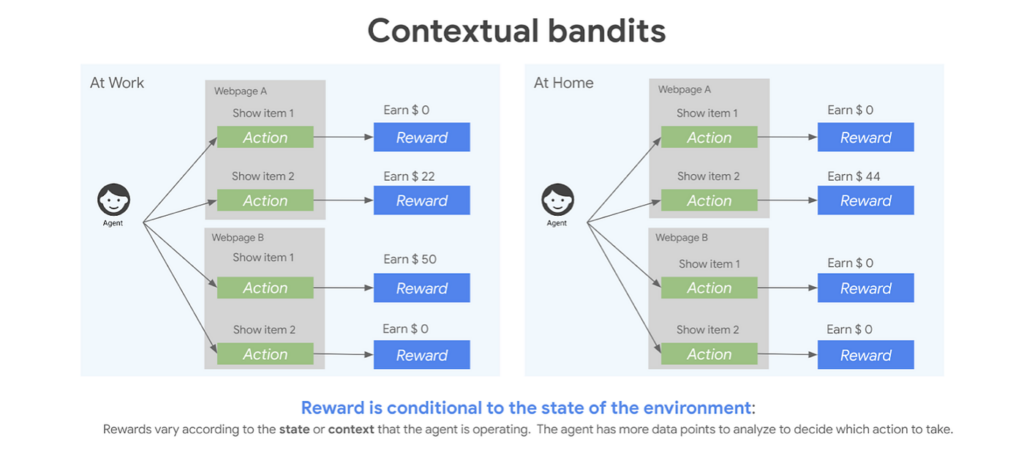
Contextual bandits refer to a framework in machine learning that combines the principles of multi-armed bandits with the use of context. Unlike traditional bandits, which operate in static environments, contextual bandits adapt their strategies based on the context available at the time of decision-making. Here, the algorithm assesses the situation and decides which action to take in order to maximize an expected reward.
To illustrate, consider an online streaming platform that recommends content to users. Each time a user logs in, the system has specific information about their preferences—such as viewing history, demographic data, and even real-time behavior. The contextual bandit algorithm utilizes this data to select which show to recommend, with the goal of maximizing viewership and user retention.
Key Components of Contextual Bandits
The contextual bandit framework encapsulates several key components:
- Context: Refers to all the available information that can influence decision-making. In a retail scenario, context may include user location, search history, and purchase patterns.
- Actions: These are the choices offered to the user. For example, this may involve showcasing different products to an online shopper.
- Rewards: The result of an action taken in a specific context is measured as a reward. In a recommendation system, this could mean clicks, purchases, or time spent on a webpage.
The Mechanism of Personalization via Contextual Bandits
The implementation of contextual bandits in personalization leverages data insights through a cycle of exploration and exploitation:
Exploration versus Exploitation
In the context of contextual bandits, the terms ‘exploration’ and ‘exploitation’ refer to the dual strategies employed to gather information:
- Exploration: This involves trying out different actions to gather data on their effectiveness. For instance, a streaming service may recommend a new genre to see if users engage with it.
- Exploitation: This is the process of utilizing the knowledge gained from past data to choose the most rewarding action. For instance, if a particular genre has shown high engagement previously, the service will more frequently recommend that genre to users.
Striking the right balance between exploration and exploitation is essential for optimizing personalization. An overly exploratory approach may result in subpar user experience, while excessive exploitation could lead to stagnation in user engagement.
Applications of Contextual Bandits in Personalization
Several industries are witnessing the transformative impact of contextual bandits on personalization, including:
1. E-commerce
In e-commerce, businesses are increasingly utilizing contextual bandits for product recommendations. For example, an online marketplace can leverage real-time browsing behaviors and user interactions to display tailored product suggestions. Contextual bandits enable continuous learning from consumer behavior, thus improving the accuracy and relevance of these recommendations over time.
2. Online Advertising
Contextual bandits play a crucial role in targeted advertising. By analyzing user demographics, past interactions with ads, and real-time engagement metrics, advertisers can serve personalized ads that resonate with users. The ability to adapt the ad content in real-time based on contextual information optimizes click-through rates and enhances overall advertising effectiveness.
3. Content Recommendation Systems
Media platforms and content providers utilize contextual bandits to curate personalized content feeds. By analyzing user preferences and behavior, these platforms can deliver tailored recommendations that keep users engaged. For instance, streaming services, news aggregators, and social media platforms deploy contextual bandits to suggest content that aligns with users’ interests and browsing history.
The Benefits of Contextual Bandits in Big Data-Powered Personalization
Implementing contextual bandits for personalization offers several advantages:
1. Adaptive Learning
Contextual bandits continuously learn from user interactions, enabling them to adapt their strategies in real-time. This leads to more relevant and timely recommendations, enhancing user satisfaction and engagement.
2. Enhanced Decision Making
The incorporation of contextual information allows businesses to make informed decisions tailored to individual preferences. Personalized experiences foster user loyalty and can significantly increase conversion rates.
3. Effective Resource Allocation
By evaluating the effectiveness of different strategies, contextual bandits allow businesses to allocate resources toward the most effective actions. This can result in an improved return on investment (ROI) for marketing campaigns and product placements.
4. Real-Time Personalization
As contextual bandits utilize real-time data, businesses can provide personalized experiences that adapt to changing user behaviors. This agility keeps users engaged and fosters a dynamic interaction environment.
Challenges and Considerations
Despite their advantages, the deployment of contextual bandits comes with its own set of challenges:
1. Data Privacy Concerns
Given the reliance on personal data for contextual understanding, businesses must navigate the complexities of data privacy regulations. Ensuring user consent and compliance with laws such as the General Data Protection Regulation (GDPR) is paramount.
2. Data Quality and Availability
The effectiveness of contextual bandits hinges on the quality and accessibility of data. Inaccurate or incomplete data can lead to poor recommendations, adversely affecting user experience. Therefore, businesses must invest in robust data collection and management systems.
3. Computational Complexity
The algorithms underlying contextual bandits can be computationally intensive, particularly when processing large datasets in real time. Organizations must ensure they have the infrastructure capable of supporting these demands.
The Future of Contextual Bandits in Big Data Personalization
As big data continues to proliferate, the role of contextual bandits in personalization is set to expand. The ongoing advancements in machine learning algorithms and computing power will facilitate even more sophisticated and nuanced personalization strategies. Moreover, the integration of contextual bandits with other AI-driven technologies, such as deep learning, will open new avenues for intelligent decision-making in personalization.
Future applications may include deeper profiling of user preferences through enhanced context analysis, leading to hyper-personalized experiences tailored to individual moments and situations. This evolution will further cement contextual bandits as a central player in the world of big data and personalization.
Contextual bandits play a vital role in leveraging Big Data for personalized recommendations and optimization in various industries. By balancing exploration and exploitation strategies, contextual bandits enable efficient decision-making processes that drive enhanced user experiences and business outcomes in the era of Big Data.
Related posts:
 How to Build an Open-Source Data Stack for Scalable Big Data Analytics
 How to Leverage Swarm Intelligence for Big Data Optimization
 The Future of Digital Twins in Large-Scale Big Data Simulations
 The Role of Causal AI in Understanding Big Data Relationships
 How to Perform Large-Scale Time Series Forecasting with Big Data
 The Role of AutoML in Scaling Big Data Model Deployment
 How to Perform Real-Time Outlier Detection in Big Data Pipelines
 The Future of AI-Powered Data Wrangling for Big Data Scientists
 The Role of Synthetic Tabular Data Generation in Big Data Training Sets
 The Impact of Transfer Learning on Large-Scale AI Models
 How to Use Apache SeaTunnel for ETL in Big Data Pipelines
 The Role of AI in Automated Feature Selection for Big Data Models
 The Future of Scalable AI-Driven Big Data Pipelines
 How to Perform Online Data Augmentation for Real-Time AI Applications