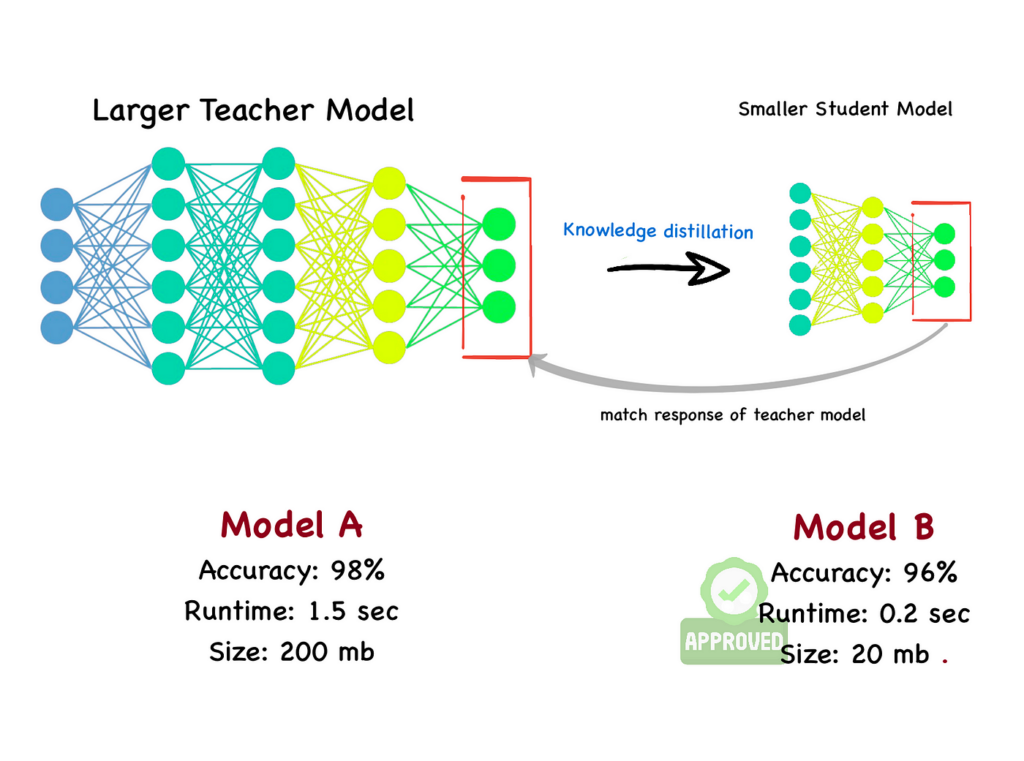
In the realm of Big Data and Artificial Intelligence (AI), the constant need for high-performing models that can handle massive datasets efficiently is ever-present. One approach that has gained traction in recent years is Knowledge Distillation, a technique used to compress large AI models without losing their predictive power. By transferring knowledge from a complex, bulky model to a smaller, more streamlined version, organizations can reduce computational resources while maintaining high accuracy levels. In this article, we will explore how Knowledge Distillation can be effectively utilized in the context of Big Data to create more scalable and practical AI solutions.
In recent years, large AI models have gained immense popularity for their ability to deliver accurate predictions and insights from big data. However, their performance often comes at the cost of substantial computational resources and memory requirements. This is where knowledge distillation plays a pivotal role, providing a method to compress these large models into smaller, more efficient ones. In this article, we will explore how to effectively use knowledge distillation for compressing large AI models.
What is Knowledge Distillation?
Knowledge distillation is a model compression technique that transfers knowledge from a larger model, often referred to as the teacher model, to a smaller, more lightweight model known as the student model. The goal is to maintain the performance of the big data capabilities while significantly reducing the model’s size and computational load.
The process involves training the student model to mimic the behavior of the teacher model by using the latter’s predictions as training data. The student model effectively learns to generalize better, even with fewer parameters, making it suitable for deployment in resource-constrained environments.
Benefits of Knowledge Distillation
There are several compelling reasons to use knowledge distillation for compressing large AI models in big data applications:
- Reduced Model Size: Knowledge distillation helps create smaller models that can be deployed on a variety of devices, from mobile phones to IoT devices.
- Faster Inference: Smaller models require less computational power, leading to quicker inference times, which is crucial when working with real-time big data analytics.
- Maintained Performance: Despite their size, properly distilled models can achieve comparable performance to their larger counterparts, making them a viable option for many applications.
- Lower Energy Consumption: Smaller models consume less energy, which is a significant advantage for large-scale deployment and sustainability considerations.
Understanding the Knowledge Distillation Process
1. Selecting the Teacher Model
The first step in the knowledge distillation process is selecting an appropriate teacher model. This model should be a well-trained, complex neural network that demonstrates high accuracy on the specific big data task you are working on. The teacher model can be based on cutting-edge architectures such as Convolutional Neural Networks (CNN) or Transformers depending on the nature of your data (e.g., images vs. text).
2. Designing the Student Model
Once you have your teacher model, the next step is to design the student model. Generally, this model should have fewer layers and parameters compared to the teacher model. However, careful consideration must be given to ensure that the student model can still capture the essential knowledge and relationships present in the data.
3. Training the Student Model
The core of knowledge distillation involves training the student model using the soft logits (predicted probabilities) generated by the teacher model. Instead of using ground truth labels exclusively, you’re augmenting the training process with the output of the teacher model:
- Soft Targets: The teacher model’s soft targets provide richer information than hard labels, enabling the student model to learn more nuanced patterns in the data.
- Temperature Scaling: A temperature parameter can be applied to the softmax output of the teacher model. Increasing the temperature allows for smoother probability distributions, helping the student model learn more effectively.
An important aspect of training the student model is adjusting the loss function. You can combine the traditional cross-entropy loss with a distillation loss that measures the difference between the teacher and student model outputs:
Knowledge Distillation offers a promising approach to compressing large AI models in the context of Big Data by transferring knowledge from a complex teacher model to a more compact student model. This method not only reduces the computational resources required for model deployment but also improves efficiency in processing vast amounts of data. By leveraging Knowledge Distillation, organizations can optimize their Big Data analytics pipelines and enhance scalability without compromising model performance, making it a valuable technique for compressing large AI models in the Big Data domain.
Related posts:
 The Five Vs of Big Data: Volume, Velocity, Variety, Veracity, and Value
 Understanding Data Pipelines in Big Data
 What is Apache Hadoop? A Complete Guide
 Understanding Apache Spark: Features and Use Cases
 Introduction to NoSQL Databases for Big Data
 Understanding HBase: How it Works in the Hadoop Ecosystem
 The Intersection of Big Data and Artificial Intelligence
 Natural Language Processing (NLP) with Big Data
 How Big Data is Used in Deep Learning Applications
 Sentiment Analysis with Big Data and AI
 Real-Time AI and Big Data: How It Works
 The Impact of Big Data on Financial Services and Banking
 Big Data in Smart Cities: Applications and Challenges
 Big Data and Retail: How It’s Changing the Shopping Experience