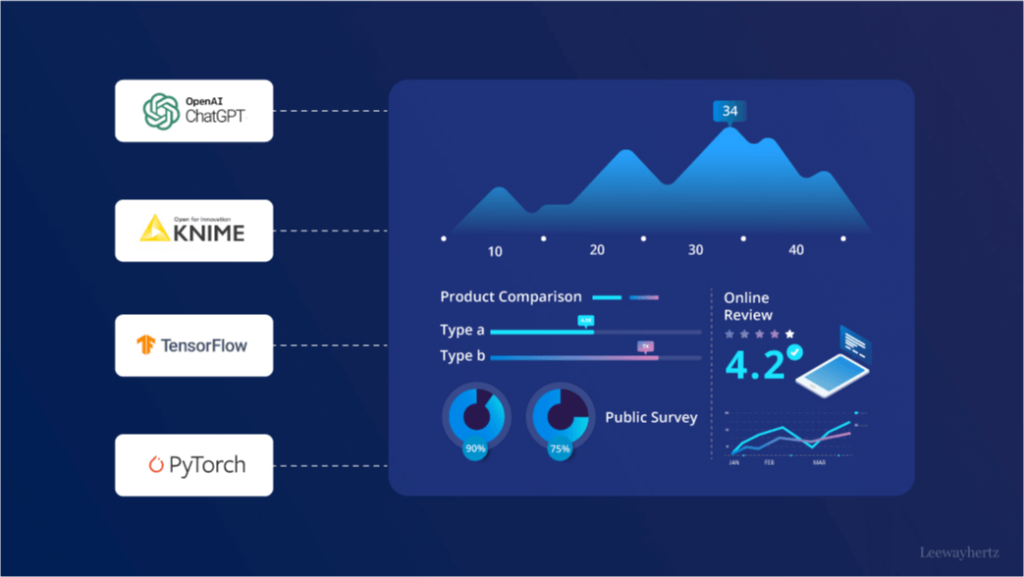
In the realm of Big Data analytics, the future of AI-augmented time series analysis holds immense potential for revolutionizing the way organizations predict trends and patterns. By leveraging artificial intelligence techniques to analyze vast amounts of time-stamped data, businesses can harness actionable insights at unprecedented speeds and scales. As the volume and velocity of data continue to grow exponentially, AI-powered time series analysis offers a promising avenue for unlocking valuable predictive capabilities that can drive strategic decision-making and enhance overall performance in the Big Data landscape.
In today’s data-driven world, businesses increasingly rely on big data to make informed decisions. One of the key areas of focus is time series analysis, which plays a crucial role in understanding trends and patterns over time. With the advent of artificial intelligence (AI), the landscape of time series analysis is evolving rapidly, thus reshaping the future of big data predictions. In this article, we will explore how AI is augmenting time series analysis and what this means for the future of big data.
Understanding Time Series Analysis
Time series analysis involves statistical methods to analyze time-ordered data points. The main objective is to extract meaningful statistics and identify patterns, trends, and seasonal variations within the data. Businesses can leverage these insights for forecasting future values based on past observations. Common applications include:
- Financial market predictions
- Supply chain management
- Sales forecasting
- Weather forecasting
- Healthcare predictions
As the volume and complexity of data continue to increase, traditional time series analysis methods often struggle to produce accurate predictions. Here is where AI steps in, providing advanced analytics capabilities that significantly enhance the predictive power of time series models.
The Role of AI in Time Series Analysis
AI, specifically machine learning (ML) and deep learning, has brought innovative methodologies to time series analysis. These technologies can process vast datasets and uncover complex, nonlinear relationships that traditional statistical methods may overlook. Here are a few ways AI is influencing time series analysis:
1. Improved Data Preprocessing
Data preprocessing is essential for accurate analysis. AI algorithms can automate and optimize data cleaning, normalization, and imputation processes. For instance, automated feature extraction identifies which features are significant predictors and reduces noise, leading to better model performance.
2. Enhanced Forecasting Models
Machine learning models, such as recurrent neural networks (RNNs) and long short-term memory (LSTM), are particularly effective in capturing temporal dependencies within time series data. These models excel at learning from past data to make predictions about future events, outperforming traditional statistical methods, particularly in highly volatile environments.
3. Handling Nonlinearity and Seasonal Trends
Time series data often exhibit non-linear patterns and seasonal trends. AI-based models are equipped to identify these complexities more effectively than conventional methods. For instance, seasonal decomposition, driven by AI, can separate seasonal effects from cyclical components, enhancing the accuracy of predictions.
Future Trends in AI-Augmented Time Series Analysis
The intersection of AI and time series analysis is poised for significant growth in the coming years. Here are some expected trends:
1. Automated Machine Learning (AutoML)
As organizations seek efficiency, AutoML tools are gaining traction. These tools automate the process of selecting models, tuning parameters, and validating results. By integrating AutoML solutions into time series analysis, organizations can streamline their forecasting processes while achieving more accurate predictions with minimal human intervention.
2. Integration with IoT Data
The rise of the Internet of Things (IoT) will lead to the generation of vast amounts of time-stamped data. AI will play a critical role in analyzing this data in real time, enabling businesses to make timely and informed decisions based on evolving conditions. For instance, real-time analytics can improve inventory management and optimize logistics in supply chains.
3. Multi-Dimensional Time Series Forecasting
AI techniques will allow for more sophisticated multi-dimensional forecasts, incorporating various influencing factors. By analyzing several related time series simultaneously, businesses can gain insights that are not apparent when examining each time series in isolation. This means improved accuracy in predicting complex interactions among variables like sales data, marketing metrics, and economic indicators.
4. Natural Language Processing (NLP) Integration
Integrating NLP with time series analysis can enhance data insights significantly. For example, businesses can extract trends and sentiments from news articles or social media posts as time series data. By correlating these insights with quantitative metrics, organizations can better understand how external factors impact their performance over time.
5. Enhanced Interpretability
While AI models are powerful, their complexity often makes them opaque. The future focus will be on increasing the interpretability of AI models used in time series analysis. Techniques such as SHAP values and LIME (Local Interpretable Model Agglomeration) will help stakeholders understand the factors driving predictions, making it easier for them to trust and act on AI-generated insights.
Challenges Facing AI-Augmented Time Series Analysis
Despite its potential, there are challenges in the field of AI-augmented time series analysis that need addressing:
1. Data Quality and Availability
The success of AI models largely depends on the quality and quantity of available data. Organizations may face challenges in obtaining clean, high-quality time series data. Ensuring robust data collection and management processes will be essential for achieving reliable predictions.
2. Overfitting and Model Complexity
AI models, particularly deep learning frameworks, risk overfitting on training data. This poses a significant threat as it can lead to inaccurate predictions in real-world scenarios. Continuous monitoring and model validation against fresh data are required to mitigate this issue.
3. Computational Resources
AI models, especially deep learning techniques, often require substantial computational power and storage capabilities. Organizations may need to invest in advanced infrastructure or leverage cloud computing solutions to handle the demands of AI-augmented time series analysis.
The Impact on Various Industries
AI-augmented time series analysis will have transformative effects across various industries:
1. Finance
In finance, AI can enhance risk assessment, fraud detection, and investment forecasting by processing vast amounts of transactional data. Improved time series predictions will enable financial institutions to mitigate risks and enhance profitability.
2. Healthcare
In healthcare, predictive analytics will help in early diagnosis, patient monitoring, and resource allocation. AI can identify trends in patient data over time, leading to better patient outcomes through timely interventions.
3. Retail
Retailers will use AI to optimize pricing strategies, inventory management, and demand forecasting by analyzing historical sales data and external factors, such as seasonality and promotional activities.
4. Manufacturing
Manufacturers will leverage time series predictions to enhance predictive maintenance, minimize downtime, and optimize production processes based on demand forecasting.
Final Thoughts
The convergence of AI and time series analysis heralds a bright future for big data predictions. As organizations adopt these innovative methodologies, they will gain unprecedented insights and capabilities that will enhance decision-making processes across various industries. By continuously evolving their approaches and investing in technology, businesses can stay ahead of the curve in a rapidly changing data landscape.
The future of AI-augmented time series analysis holds great promise for enhancing the accuracy, efficiency, and scalability of big data predictions. Leveraging advanced AI technologies in time series analysis enables organizations to extract valuable insights, make informed decisions, and unlock new opportunities in the evolving landscape of big data analytics. Embracing these innovations will be crucial for staying competitive and driving business success in the era of big data.
Related posts:
 Understanding Data Pipelines in Big Data
 What is Apache Hadoop? A Complete Guide
 Introduction to NoSQL Databases for Big Data
 Understanding HBase: How it Works in the Hadoop Ecosystem
 Natural Language Processing (NLP) with Big Data
 How Big Data is Used in Deep Learning Applications
 Sentiment Analysis with Big Data and AI
 Big Data in Smart Cities: Applications and Challenges
 Big Data and Retail: How It’s Changing the Shopping Experience
 Big Data in Agriculture: Precision Farming and Analytics
 What is Predictive Analytics in Big Data?
 Data Science vs. Big Data Analytics: Key Differences
 Data Partitioning Strategies for Big Data Scalability
 The Importance of Data Governance in Big Data