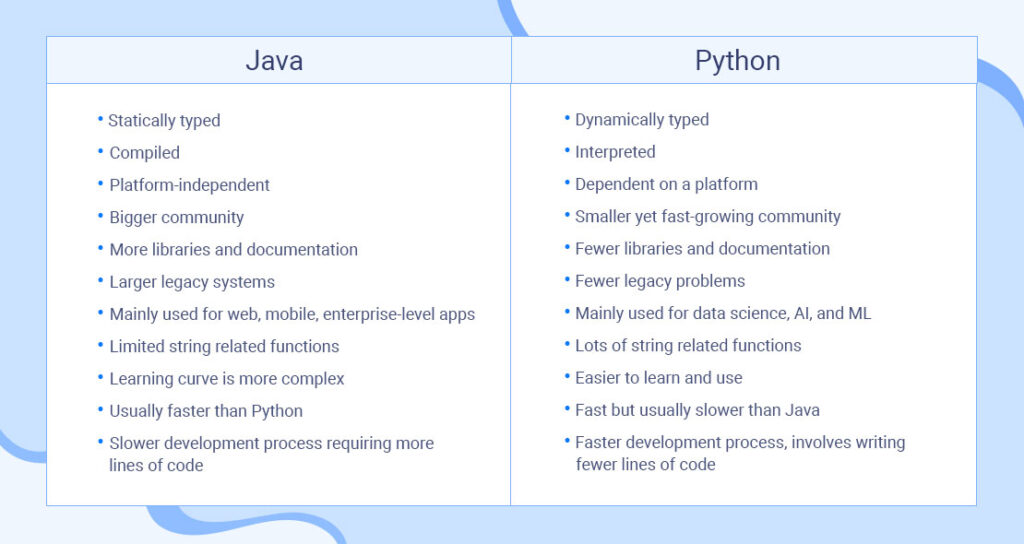
The ongoing debate about whether Python will eventually surpass Java in speed has garnered significant attention within the programming community. Python, known for its simplicity and readability, has historically been criticized for its slower execution compared to Java, a language recognized for its performance and speed. However, recent advancements in Python’s optimization techniques and the emergence of new projects like PyPy and Cython have sparked discussions on the potential for Python to bridge the speed gap with Java.
While Java has long been favored for its speed and efficiency in performance-critical applications, Python’s growing popularity and continual evolution have raised questions about the possibility of it outperforming Java in the future. With both languages constantly improving and adapting to meet the demands of modern software development, the competition between Python and Java in terms of speed is a compelling topic that continues to intrigue developers and tech enthusiasts alike.
In the world of programming languages, Python and Java are two of the most popular choices among developers. Both languages have their unique strengths and weaknesses, but one question that often arises is whether Python will ever surpass Java in terms of speed and performance. This article delves into the current state of Python and Java as well as the trends and advancements that may influence their relative speeds in the future.
Understanding Python and Java
Python is a high-level, interpreted programming language known for its simplicity and readability. It emphasizes code readability and reduces the required lines of code, making it an excellent choice for beginners and rapid prototyping. However, Python’s interpreted nature can introduce performance limitations compared to compiled languages like Java.
Java, on the other hand, is a strongly-typed, compiled programming language designed to be platform-independent. It utilizes a virtual machine called the Java Virtual Machine (JVM), which allows it to be run on different systems without recompilation. Java’s compilation process gives it a performance advantage over Python, especially when dealing with computationally intensive tasks.
The Current Performance of Python and Java
As of now, Java typically outperforms Python when it comes to speed and performance. The primary reason for this is the difference in their execution models. Java’s byte code is compiled to machine code, which allows it to directly run on the target platform, resulting in faster execution. Python, being an interpreted language, requires an interpreter to execute the code, adding an additional layer of interpretation, which can slow down the execution speed.
However, it is important to note that performance disparities between programming languages are highly context-dependent. While Java is generally faster, Python’s performance can be improved through the use of external libraries, optimizing the code, and leveraging just-in-time (JIT) compilation techniques. In certain scenarios, Python can even match or exceed Java’s performance.
The Future of Python’s Performance
Python’s development community is continuously working on enhancing the language’s performance. One significant improvement is the introduction of Python 3, which provides various performance enhancements over its predecessor, Python 2. The adoption of Python 3 has increased in recent years.
Furthermore, Python has various third-party libraries, such as NumPy and Pandas, that enhance its performance in scientific computing and data analysis tasks. These libraries utilize optimized C and Fortran code, providing near-native performance. The expansion of such libraries will likely continue to improve Python’s performance in specific domains.
Additionally, techniques like JIT compilation offer potential speed improvements to Python. Projects like PyPy, which is an alternative implementation of the Python language, utilize JIT compilation techniques and have demonstrated notable performance gains. As JIT compilation techniques mature, Python’s overall speed could significantly improve.
The Advancements in Java’s Performance
The Java ecosystem is also continuously evolving and introducing advancements to improve its performance. The Java Virtual Machine (JVM) has seen numerous updates, optimizations, and just-in-time (JIT) compilation techniques that enhance runtime execution speed. With each new release, Java aims to further optimize its performance.
Additionally, Java has a vast ecosystem of libraries and frameworks, such as Apache Spark and Hadoop, which are designed to handle large-scale data and parallel processing. These tools enable Java to excel in big data analytics and distributed computing tasks, further enhancing its performance in specific domains.
The Impact of Hardware Advancements
Another crucial factor in determining programming language performance is hardware. As technology progresses, hardware advancements have the potential to benefit both Python and Java. Improvements in processor speeds, memory management, and parallel computing capabilities can positively impact the overall performance of programming languages.
For instance, the rise of multi-core processors and the accessibility of distributed computing frameworks open the door for both Python and Java to leverage parallel processing. As developers optimize their code to take advantage of parallelism, significant performance improvements can be achieved in both languages.
In conclusion, while Java currently reigns supreme in terms of speed and performance, Python is actively working towards closing the gap. With continued advancements in both languages, it’s difficult to predict whether Python will become faster than Java in the long run. However, it is clear that Python’s performance has been improving steadily, with the aid of external libraries, JIT compilation, and language enhancements. Java, on the other hand, relies on its robust ecosystem and runtime optimization techniques to maintain its performance edge.
Ultimately, the choice of programming language should be made based on the specific requirements of each project. Python’s simplicity and ease of use make it a popular choice for many applications, while Java’s performance benefits are well-suited for computationally demanding tasks. Both languages have their strengths and will continue to evolve as technology progresses, ensuring a vibrant future for the programming community.
The debate over whether Python will become faster than Java remains ongoing, with various factors influencing the performance of each language. Both languages have their strengths and weaknesses, and it ultimately depends on the specific use case and optimizations made by developers. As technology continues to advance, it is possible that Python may eventually surpass Java in terms of speed, but for now, both languages continue to evolve and improve in their own unique ways.
Related posts:
 Can you make games in Python?
 Is Python enough to get a job?
 What will replace Python?
 Is 30 too old to learn Python?
 Is C required to learn Python?
 What kind of jobs can you get knowing Python?
 What problems can Python solve?
 Which country is best for Python programming?
 Can Python make 3D games?
 Can I learn Python at 45 and get a job?
 Do I need to learn C++ if I know Python?
 Can I learn Python without knowing C and C++?
 Is HTML difficult than Python?
 Should I learn C or C++ before Python?