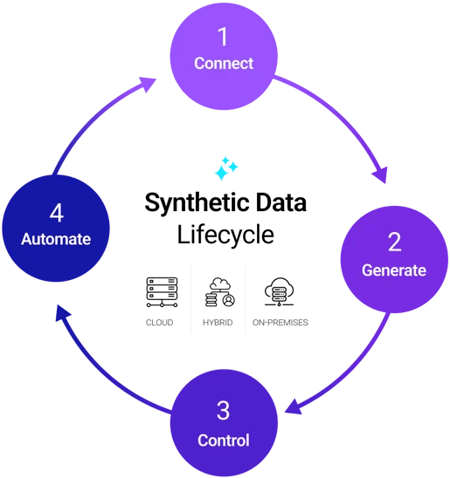
In the realm of Big Data, the generation of synthetic data plays a crucial role in driving innovation and advancement. Synthetic data refers to artificially created data that mimics the characteristics of real-world data while protecting sensitive information. This process is integral for various Big Data applications, including machine learning, predictive analytics, and data mining. By utilizing synthetic data, organizations can overcome challenges related to data privacy, scarcity of real data, and regulatory constraints. This approach not only facilitates the development and testing of algorithms but also enables researchers and data scientists to explore new possibilities and insights within the realm of Big Data.
Synthetic data generation has emerged as a pivotal innovation in the realm of big data, fundamentally reshaping how organizations approach data processing, analysis, and application. As real-world data continues to grow in both volume and complexity, synthetic data serves as a viable alternative that enables companies to unlock insights without compromising privacy or security.
Understanding Synthetic Data
Synthetic data refers to data that is artificially generated rather than obtained by direct measurement. It mimics the statistical characteristics of real datasets, providing a safe and ethical way to handle data that can be used for various applications such as machine learning, software testing, and data analysis. By employing advanced algorithms and generative models, synthetic data generation can produce datasets that retain the essential patterns and features of the original datasets.
Benefits of Synthetic Data Generation
One of the key benefits of synthetic data generation is its ability to mitigate the risks associated with data privacy and security. When handling sensitive information such as personal identifiable information (PII), organizations must comply with strict regulations like GDPR and HIPAA. Using synthetic data allows companies to perform analyses and training on data that poses no risk to individual privacy.
Moreover, synthetic data generation enables the creation of large datasets from a small number of real data points. This aspect is particularly beneficial in scenarios where gathering real-world data is costly, time-consuming, or impractical. Thus, businesses can significantly reduce the time to market for their data-driven products.
Applications of Synthetic Data in Big Data
Synthetic data finds diverse applications across various industries within the big data landscape:
1. Machine Learning
In the machine learning domain, having a robust training dataset is crucial for the success of models. Often, collecting enough labeled data is a significant challenge. Synthetic data generation can create vast amounts of labeled datasets that can be used to train models effectively, improving accuracy and performance without the need for extensive data collection efforts.
2. Software Testing
In software development, quality assurance (QA) is vital to delivering high-quality products. Synthetic data can be used in testing applications where real data may be inadequate or unavailable. By using artificial datasets, developers can simulate real-world scenarios to observe how the system behaves under various conditions.
3. Data Augmentation
Data augmentation involves enhancing existing datasets by creating variations to improve model robustness. Synthetic data can serve as a powerful tool for data augmentation, allowing models to learn from a wider variety of inputs which can lead to better generalization across different use cases.
4. Anonymizing Data for Sharing
Organizations often need to share data with third parties to collaborate on research or analyses while ensuring compliance with privacy laws. Synthetic data generation provides a solution by allowing organizations to create anonymized versions of their datasets, enabling safe sharing without revealing sensitive information.
The Technology Behind Synthetic Data Generation
The generation of synthetic data involves the use of sophisticated technologies that include:
1. Generative Adversarial Networks (GANs)
One of the most popular methods for generating synthetic data is through Generative Adversarial Networks (GANs). GANs consist of two neural networks—a generator and a discriminator—that work against each other. The generator creates synthetic data, while the discriminator evaluates it against real data. Over time, the generator improves its output until the synthetic data becomes indistinguishable from the real data.
2. Variational Autoencoders (VAEs)
Variational Autoencoders (VAEs) are another type of model employed for synthetic data generation. VAEs work by compressing input data into a latent space and then reconstructing it, thereby yielding new samples that are similar to the training data. This process allows VAEs to generate diverse outputs that maintain the original data’s structural integrity.
3. Simulation-based Approaches
In some cases, synthetic data can be generated through simulation-based approaches, where mathematical models or algorithms mimic real-world processes. This method is useful in industries such as finance and healthcare, where specific scenarios can be modeled to create synthetic datasets for analysis.
Challenges and Considerations in Synthetic Data Generation
While the benefits of synthetic data are undeniable, there are challenges and considerations to take into account:
1. Quality and Realism
The quality of synthetic data must accurately reflect the real-world data it is intended to replace. Generating synthetic data that lacks realism can lead to misleading outcomes and undermine the validity of machine learning models. Organizations must ensure rigorous testing and validation of synthetic datasets before deploying them in decision-making processes.
2. Algorithmic Bias
One significant concern with synthetic data generation is that it can inadvertently reinforce existing biases present in the training data. If the underlying model used for generation learns from biased data, the synthetic outputs may also carry those biases, potentially leading to skewed insights and unfair recommendations.
3. Domain-Specific Limitations
Different industries have unique data requirements, and the transition from real data to synthetic data must be carefully managed. Organizations must assess the domain relevance of synthetic datasets to ensure they meet the context-specific needs of their applications.
The Future of Synthetic Data in Big Data
As big data continues to expand, the role of synthetic data generation is likely to grow significantly. With advancements in AI and machine learning, new methods for generating synthetic data will become more sophisticated, facilitating more accurate and realistic datasets.
Additionally, regulations concerning data privacy will continue to evolve, pushing organizations to adopt synthetic data generation as a standard practice. The ability to create datasets that comply with privacy regulations while still yielding valuable insights will drive adoption across sectors.
Conclusion: Embracing Synthetic Data in the Big Data Era
In summary, synthetic data generation is transforming the landscape of big data. By providing solutions that enable the development of robust, secure, and meaningful datasets, organizations can stay ahead of the curve in this rapidly evolving digital environment. As technology progresses, we can anticipate the integration of synthetic data generation into more data systems, fundamentally altering how we perceive, utilize, and exploit data.
Synthetic data generation plays a crucial role in addressing the complexities and challenges associated with big data, enabling scalable and efficient data processing, analysis, and model training. By generating realistic data sets that reflect the characteristics of the original data, synthetic data helps in ensuring data privacy, security, and compliance while promoting innovation and advancements in various fields dependent on big data analytics. Embracing synthetic data generation techniques is key to maximizing the value and potential of big data in today’s data-driven world.
Related posts:
 The Five Vs of Big Data: Volume, Velocity, Variety, Veracity, and Value
 Understanding Data Pipelines in Big Data
 What is Apache Hadoop? A Complete Guide
 Introduction to NoSQL Databases for Big Data
 Understanding HBase: How it Works in the Hadoop Ecosystem
 Natural Language Processing (NLP) with Big Data
 How Big Data is Used in Deep Learning Applications
 Sentiment Analysis with Big Data and AI
 Real-Time AI and Big Data: How It Works
 The Impact of Big Data on Financial Services and Banking
 Big Data in Smart Cities: Applications and Challenges
 Big Data and Retail: How It’s Changing the Shopping Experience
 Big Data in Agriculture: Precision Farming and Analytics
 What is Predictive Analytics in Big Data?