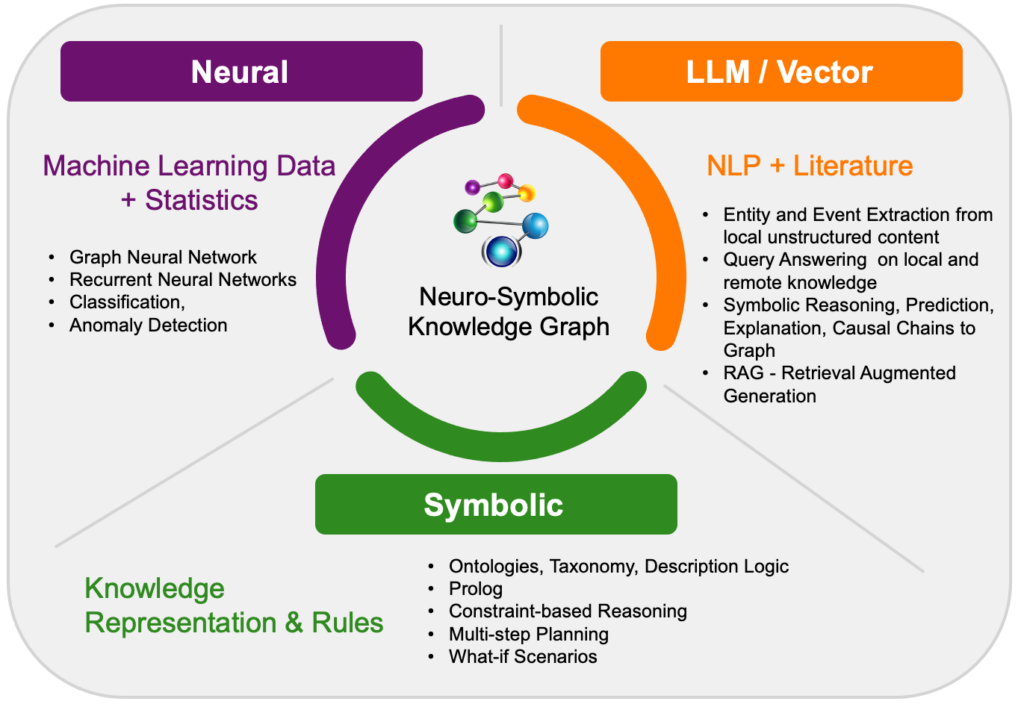
In the realm of Big Data analytics, the fusion of neural networks and symbolic reasoning, known as Neural-Symbolic AI, is gaining increasing attention for its potential to enhance reasoning capabilities. By combining the deep learning capabilities of neural networks with the symbolic processing power of traditional AI, Neural-Symbolic AI offers a promising approach to extract valuable insights and patterns from large and complex datasets. This synergy allows for more sophisticated and context-aware reasoning over Big Data, leading to more accurate predictions, better decision-making, and ultimately, deeper understanding of the data at hand. In this article, we will delve into the role of Neural-Symbolic AI in advancing Big Data reasoning and explore its implications for data-driven applications.
Neural-symbolic AI is rapidly becoming a significant area in the field of artificial intelligence, particularly in its application to big data reasoning. Combining the strengths of neural networks and symbolic reasoning, this approach presents unique capabilities that can revolutionize how we process and interpret large datasets. This article delves into the mechanisms through which neural-symbolic AI enhances big data reasoning, its applications, and the implications it has for various industries.
Understanding Neural-Symbolic AI
At its core, neural-symbolic AI integrates two foundational paradigms of artificial intelligence:
- Neural networks, which excel in learning from large amounts of unstructured data, and
- Symbolic reasoning, which formalizes knowledge structures and logical reasoning capabilities.
This hybrid approach allows for a more comprehensive understanding of data by enabling machines to learn from vast datasets while applying logical reasoning to draw conclusions. By leveraging both paradigms, neural-symbolic systems can offer deeper insights into complex data relationships.
Enhancing Reasoning with Neural-Symbolic AI
Neural-symbolic AI enhances big data reasoning through several key capabilities:
1. Improved Interpretability
One of the significant challenges associated with big data analytics is the interpretability of models, especially those derived from complex neural networks. Traditional neural networks often operate as “black boxes,” making it difficult for humans to comprehend how decisions are made. However, by incorporating symbolic reasoning, neural-symbolic AI provides a framework that synthesizes human-readable logic with neural learning. This allows stakeholders to better understand the reasoning behind model predictions.
2. Knowledge Integration
Neural-symbolic AI facilitates the integration of external knowledge bases with learned data representations. For instance, neural networks can acquire knowledge from vast datasets, while symbolic components can contribute an understanding of formal rules and relationships defined in structured ontologies. This enables the generation of more robust models that can reason beyond mere data correlation, leading to more accurate predictions and insights.
3. Contextual Awareness
Big data often comes from various sources with diverse contexts. Neural-symbolic architectures can embed contextual information into the reasoning process, helping models to adapt their inferences based on supplementary knowledge. For example, when analyzing customer data, knowledge about economic trends can enhance a model’s ability to predict consumer behavior effectively.
Applications of Neural-Symbolic AI in Big Data
Neural-symbolic AI has profound implications for various domains where big data reasoning is crucial:
1. Healthcare
In the healthcare sector, neural-symbolic AI can be instrumental in enhancing diagnosis accuracy and treatment recommendations. By combining patient data (from electronic health records, imaging data, etc.) with established medical knowledge and treatment protocols, these systems can assist professionals in making informed decisions supported by data-driven insights.
2. Finance
The financial industry is characterized by the rapid exchange of massive datasets. Neural-symbolic approaches can be vital for risk assessment and fraud detection. By analyzing transaction data while embodying regulatory frameworks and risk management principles in symbolic form, these systems increase the reliability of fraud detection mechanisms and regulatory compliance analyses.
3. Autonomous Systems
In the development of autonomous vehicles, neural-symbolic AI can enhance decision-making processes by allowing these systems to navigate complex environments. Utilizing vast amounts of sensor data combined with symbolic knowledge about traffic rules, road layouts, and human behavior allows for improved safety and efficiency in navigation systems.
4. Natural Language Processing (NLP)
NLP systems benefit from neural-symbolic AI, which enables machines to understand not just the semantics but also the pragmatics of language. Integrating strong reasoning capabilities ensures that chatbots and voice assistants interpret user intents accurately, providing more natural and effective interactions based on context and prior knowledge.
Challenges and Considerations
Despite its promising potential, several challenges remain in the deployment of neural-symbolic AI in big data reasoning:
1. Complexity of Integration
Developing systems that leverage both neural networks and symbolic reasoning involves significant complexity. Ensuring seamless integration while maintaining performance and interpretability poses a challenge that researchers must address.
2. Scalability
While neural-symbolic AI can enhance reasoning, scalability to massive datasets can be challenging. Techniques and methodologies that optimize performance without compromising quality are crucial for practical applications in big data contexts.
3. Data Quality and Noise
Big data often includes noise and irrelevant information that can mislead reasoning processes. Robust methodologies for data cleaning and preprocessing are essential to ensure that neural-symbolic systems can learn effectively and yield valid insights from real-world datasets.
Future Directions and Trends
The scope of neural-symbolic AI in enhancing big data reasoning continues to expand, with several key trends emerging:
1. Advances in Learning Algorithms
As research progresses, new algorithms that improve the synergy between neural and symbolic components are being developed. These advancements will enhance both the efficacy and efficiency of neural-symbolic systems, making them more adept at reasoning over big data.
2. Increased Adoption in Industry
Industries across the spectrum are starting to recognize the potential of neural-symbolic AI. From manufacturing to customer service, companies are increasingly investing in technologies that combine data analytics with intelligent reasoning capabilities.
3. Cross-disciplinary Research
Neural-symbolic AI’s applicability spans various disciplines, leading to cross-disciplinary research that can yield innovative solutions. By combining expertise from fields such as linguistics, cognitive science, and data engineering, new approaches to big data reasoning are likely to emerge.
Conclusion: The Future of Neural-Symbolic AI and Big Data Reasoning
As this evolving technology continues to mature, the role of neural-symbolic AI in big data reasoning will only grow. By leveraging both the learning power of neural networks and the logical reasoning capabilities of symbolic AI, organizations can expect to unlock new levels of understanding and insights from their data, ultimately leading to more strategic decision-making and innovation in various fields.
The fusion of neural networks and symbolic AI offers a promising approach to improving big data reasoning by combining the strengths of both paradigms. This integration enables more effective handling of complex and unstructured data, leading to enhanced decision-making and insights from large datasets. Incorporating neural-symbolic AI into big data analytics has the potential to revolutionize how businesses and organizations leverage data for innovation and growth.
Related posts:
 The Five Vs of Big Data: Volume, Velocity, Variety, Veracity, and Value
 Introduction to Distributed Computing in Big Data
 Understanding Data Pipelines in Big Data
 What is Apache Hadoop? A Complete Guide
 Understanding Apache Spark: Features and Use Cases
 Introduction to NoSQL Databases for Big Data
 Understanding HBase: How it Works in the Hadoop Ecosystem
 The Intersection of Big Data and Artificial Intelligence
 Natural Language Processing (NLP) with Big Data
 How Big Data is Used in Deep Learning Applications
 Sentiment Analysis with Big Data and AI
 Real-Time AI and Big Data: How It Works
 The Impact of Big Data on Financial Services and Banking
 Big Data in Smart Cities: Applications and Challenges