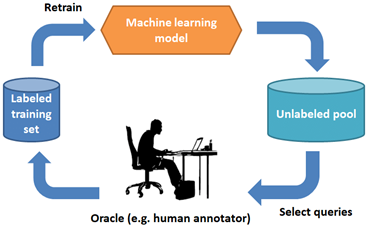
In the realm of Big Data analytics, the process of training machine learning models efficiently is paramount to achieving accurate and scalable results. One powerful technique that leverages the benefits of Big Data for model training is Batch Active Learning. This method intelligently selects the most informative data points for labeling, allowing the model to learn and improve with minimal human intervention. By strategically choosing batches of data to train the model, Batch Active Learning maximizes the use of computational resources and speeds up the learning process, making it a valuable tool for efficiently training models on large Big Data sets.
Active learning is a powerful technique in the realm of Machine Learning that enables models to intelligently select the most informative samples for training, thus minimizing the amount of labeled data required. When working with Big Data, traditional learning methods often become computationally expensive and inefficient. Batch Active Learning addresses these challenges by allowing multiple data points to be selected in a single batch. In this article, we will explore the steps to perform batch active learning for efficient model training concerning big data.
Understanding Batch Active Learning
Batch Active Learning combines two essential concepts: active learning and batch processing. Active learning reduces labeling costs by selecting a subset of data from a larger pool for which the model is uncertain. In batch active learning, instead of selecting one sample at a time, a batch of samples is chosen based on specific criteria. This is particularly useful when working with large datasets in big data contexts, where labeling data can be expensive and time-consuming.
Key Steps in Performing Batch Active Learning
1. Data Preparation
Before embarking on a batch active learning approach, prepare your data:
- Gather a large and diverse dataset that represents the problem domain.
- Preprocess data to handle missing values, normalize features, and reduce dimensionality using techniques such as Principal Component Analysis (PCA) or Feature Selection.
- Split your dataset into a training set and a pool of unlabeled data.
2. Initial Model Training
Train an initial model using a small labeled dataset. This model acts as a baseline and will provide predictions for the unlabeled pool. You may use algorithms such as:
- Random Forests
- Support Vector Machines (SVM)
- Deep Neural Networks (DNN)
This step is crucial because the performance of the initial model will directly influence the subsequent selection of batches.
3. Uncertainty Sampling
In batch active learning, the next step is to select the most informative samples from the unlabeled pool. A popular method for this is uncertainty sampling. With this method, you select samples for which the model is least certain. Various strategies for uncertainty sampling include:
- Predictive Entropy: Calculate the entropy of the predicted probability distribution. Higher entropy indicates higher uncertainty.
- Margin Sampling: Select samples for which the difference in predicted probabilities between the top two classes is minimal.
- Least Confidence Sampling: This method involves choosing instances with the lowest confidence levels in their predictions.
You can also combine these methods for better results!
4. Batch Selection
In batch selection, you can extend the uncertainty sampling to form a subset (or batch) of samples. The goal is to maximize diversity within the batch while maintaining the informativeness of the instances. You can achieve this using techniques such as:
- Clustering: Perform clustering on the unlabeled pool and select representatives from each cluster.
- Maximal Margin Criterion: Ensure that selected samples span the feature space effectively to minimize redundancy.
The selected batch will be labeled in the next steps.
5. Labeling the Selected Batch
Once your batch has been selected, the next step is to label these instances. Engage domain experts or use crowd-sourcing platforms like AWS Mechanical Turk to obtain labels for your chosen samples. Ensure the quality of labels, as poor labeling will negatively impact the performance of your model. After obtaining the labels, combine them with your existing labeled dataset.
6. Iterative Training
With the newly labeled samples, re-train your model. This step is crucial because feeding the model with the most informative data should enhance its learning capabilities. You can iterate over several cycles of batch selection and labeling to continuously improve the model’s performance. Monitor key performance indicators (KPIs) such as accuracy and loss during these iterations to gauge improvements.
7. Evaluation of Model Performance
After multiple training iterations, evaluate your model using a separate validation dataset that was not used in any previous stages. Key metrics to consider during evaluation include:
- Accuracy: Measure the proportion of correctly predicted instances.
- Precision and Recall: Assess the model’s ability to make true positive predictions.
- F1 Score: A balance between precision and recall, providing a single metric for comparison.
These evaluations will help you ascertain the effectiveness of the batch active learning process in relation to your specific dataset needs.
8. Fine-tuning Hyperparameters
As the active learning process continues, fine-tune your model’s hyperparameters. Utilizing techniques such as Random Search or Grid Search, you can explore a combination of hyperparameter values to find the optimal parameters that improve the model performance while working with batch sizes.
9. Deployment of the Model
After achieving satisfactory performance, proceed with model deployment. Ensure that the model is properly integrated into your application, and establish monitoring tools to keep an eye on its performance in real-time. Pay attention to how it performs in the production environment and gather new data periodically.
Best Practices in Batch Active Learning
Here are some best practices to enhance the efficiency of your batch active learning process:
- Start small: Begin with a smaller subset of data to evaluate the active learning approach before scaling.
- Use diverse sampling: Maintain diversity in the batch to prevent redundancy and ensure broad coverage of the data space.
- Leverage transfer learning: Use pre-trained models, especially in deep learning contexts, to initialize your model.
- Feedback loop: Establish a robust feedback mechanism to collect unlabeled data continuously and retrain the model as needed.
By adhering to these best practices, you can optimize the performance of your batch active learning strategy in big data environments.
Conclusion
In this article, we discussed the effective implementation of batch active learning for efficient model training in big data contexts. By employing techniques like uncertainty sampling and iterative training, we can develop robust models while reducing labeling costs. Moving forward, as data continues to scale, leveraging these strategies will be crucial in building intelligent systems capable of making informed decisions based on the wealth of data available.
Leveraging batch active learning for efficient model training in the realm of Big Data allows for the strategic selection of informative data samples to improve model performance while minimizing labeling efforts. This iterative approach optimizes the learning process, enabling more accurate and robust models to be trained with reduced computational and human resource costs. Embracing batch active learning methodologies in Big Data applications can significantly enhance the overall efficiency and effectiveness of machine learning systems.
Related posts:
 The Five Vs of Big Data: Volume, Velocity, Variety, Veracity, and Value
 Introduction to Distributed Computing in Big Data
 Understanding Data Pipelines in Big Data
 What is Apache Hadoop? A Complete Guide
 Understanding Apache Spark: Features and Use Cases
 Introduction to NoSQL Databases for Big Data
 Understanding HBase: How it Works in the Hadoop Ecosystem
 The Intersection of Big Data and Artificial Intelligence
 Natural Language Processing (NLP) with Big Data
 How Big Data is Used in Deep Learning Applications
 Sentiment Analysis with Big Data and AI
 Real-Time AI and Big Data: How It Works
 The Impact of Big Data on Financial Services and Banking
 Big Data in Smart Cities: Applications and Challenges