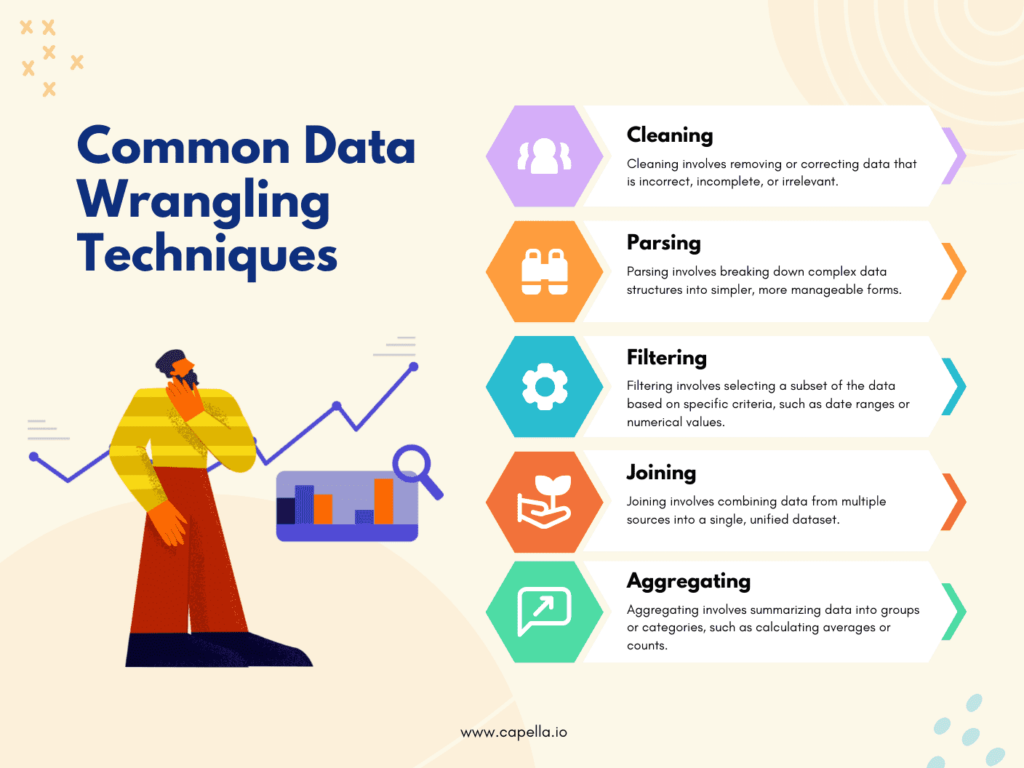
Data wrangling refers to the process of cleaning, organizing, and transforming raw data into a usable form for analysis. When dealing with large datasets in the realm of Big Data, data wrangling techniques become crucial for ensuring data quality and making the data useful for insights and decision-making. These techniques involve handling complex data structures, dealing with missing values, outliers, and inconsistencies, as well as merging and reshaping datasets. Data wrangling for large datasets requires efficient tools and approaches to handle the volume, velocity, and variety of data characteristic of Big Data. By mastering data wrangling techniques for large datasets, organizations can extract valuable information and derive actionable insights from their data assets.
Data wrangling, also known as data munging, is a crucial process in the realm of Big Data. It involves cleaning, organizing, and transforming raw data into a usable format. When handling large datasets, proper data wrangling techniques are essential for effective data analysis. Below, we explore various data wrangling techniques tailored specifically for large datasets.
1. Understanding Data Wrangling
Before diving into specific techniques, it’s vital to grasp the concept of data wrangling. This process typically involves several stages:
- Data Collection: Gathering data from various sources.
- Data Cleaning: Identifying and correcting errors.
- Data Transformation: Formatting and adjusting data structures.
- Data Enrichment: Adding additional context or information.
2. Essential Techniques for Data Wrangling
2.1. Data Profiling
Data profiling is the first step in understanding large datasets. It involves examining the data to discover patterns, anomalies, and data types. Key practices include:
- Assessing data quality metrics, such as completeness and uniqueness.
- Detecting data types and any discrepancies.
- Identifying correlations between different data fields.
2.2. Data Cleaning Techniques
Once you have profiled your data, the next step is data cleaning. This is especially critical with large datasets where the volume of data anomalies can skew insights. Common techniques include:
- Removing Duplicates: Duplicate records can skew results. Use algorithms to identify and eliminate these duplicates.
- Handling Missing Values: Determine whether to fill in, interpolate, or remove missing values based on their significance and quantity.
- Outlier Detection: Use statistical methods to identify and handle outliers that may affect your analysis.
- Standardization: Normalize data formats, such as dates, currency, and categorical variables.
2.3. Data Transformation Techniques
Data transformation includes converting data from one format to another, making it suitable for further analysis:
- Aggregation: Summarizing detailed data to a higher level using functions like sum, average, or count.
- Normalization: Scaling numerical data into a range, often between 0 and 1, to improve the performance of algorithms.
- Pivoting and Unpivoting: Restructuring data to either rotate rows to columns or vice versa, facilitating better analysis.
- Encoding Categorical Variables: Convert categorical variables into numeric values through techniques like one-hot encoding or label encoding.
2.4. Data Integration
For many organizations, data comes from multiple sources. Data integration involves merging data from different databases or systems:
- Schema Matching: Aligning different data source schemas to create a unified dataset.
- ETL Processes: Employing Extract, Transform, Load (ETL) strategies to pull in data from various sources into a central repository.
- APIs: Utilizing APIs to connect to live data sources and automate data fetching processes.
2.5. Data Enrichment
Data enrichment adds value to your data by integrating external data sources. This helps to build a more comprehensive dataset that supports deeper analysis:
- External Data Sources: Incorporate data from public datasets, third-party APIs, or machine learning models to enhance your existing data.
- Feature Engineering: Create new features that can lead to more insightful analysis or improved model performance.
3. Tools for Data Wrangling
3.1. Open Source Tools
- Pandas: A powerful Python library widely used for data manipulation and analysis, especially suitable for large datasets.
- Apache Spark: Designed for big data processing, Spark allows for distributed data processing across a cluster.
- Dask: Built as a parallel computing library, Dask enables scalable data analytics.
3.2. Commercial Tools
- Alteryx: An intuitive platform for data blending and advanced analytics.
- Tableau Prep: Helps data professionals clean and prepare data visually for seamless integration with Tableau analytics.
- Talend: Provides connectors and features for data integration and transformation.
4. Best Practices for Data Wrangling
Implementing effective data wrangling techniques requires adherence to best practices:
- Automate Processes: Whenever possible, automate repetitive tasks to save time and minimize errors.
- Document Changes: Maintain clear records of all transformations and cleaning steps taken for transparency and reproducibility.
- Version Control: Use version control systems (e.g., Git) to keep track of data changes and access historic versions.
- Test Your Data: Regularly run tests on the data quality and integrity to ensure consistency and reliability.
5. Challenges in Data Wrangling
While data wrangling is essential, various challenges can arise, especially with large datasets:
- Scalability: As data volume increases, algorithms and tools need to efficiently handle larger datasets without compromising performance.
- Data Diversity: Data may originate from various sources, often with inconsistent formats and structures, complicating integration.
- Quality Control: Maintaining data quality across large datasets requires sustained efforts and resources.
6. The Future of Data Wrangling
The field of data wrangling is evolving continually, driven by technological advancements and the growing need for data-driven decision-making:
- Machine Learning: ML models are increasingly used to automate parts of the data wrangling process, enhancing efficiency.
- AI-Powered Tools: New tools are emerging that leverage artificial intelligence to streamline and improve data wrangling tasks.
- Real-Time Data Processing: The demand for real-time data analysis is pushing innovations in data wrangling techniques, enabling quicker insights.
As the volume of data continues to grow exponentially, mastering these data wrangling techniques will become even more critical for businesses aiming to leverage Big Data effectively. Understanding the intricacies of data wrangling equips professionals to transform raw data into valuable assets, driving organizational success through informed decision-making.
Mastering data wrangling techniques for large datasets is a crucial skill in the realm of Big Data. Effective data wrangling enables organizations to efficiently preprocess and clean vast amounts of data, ensuring its suitability for downstream analysis and decision-making. By implementing best practices such as data transformation, cleaning, and normalization, businesses can derive valuable insights and leverage the full potential of their data assets. Investing in robust data wrangling processes is essential for maximizing the value and extracting actionable intelligence from large datasets in the era of Big Data.
Related posts:
 The Five Vs of Big Data: Volume, Velocity, Variety, Veracity, and Value
 Understanding Data Pipelines in Big Data
 What is Apache Hadoop? A Complete Guide
 Understanding Apache Spark: Features and Use Cases
 Introduction to NoSQL Databases for Big Data
 Understanding HBase: How it Works in the Hadoop Ecosystem
 Natural Language Processing (NLP) with Big Data
 How Big Data is Used in Deep Learning Applications
 Sentiment Analysis with Big Data and AI
 Real-Time AI and Big Data: How It Works
 The Impact of Big Data on Financial Services and Banking
 Big Data in Smart Cities: Applications and Challenges
 Big Data and Retail: How It’s Changing the Shopping Experience
 Big Data in Agriculture: Precision Farming and Analytics