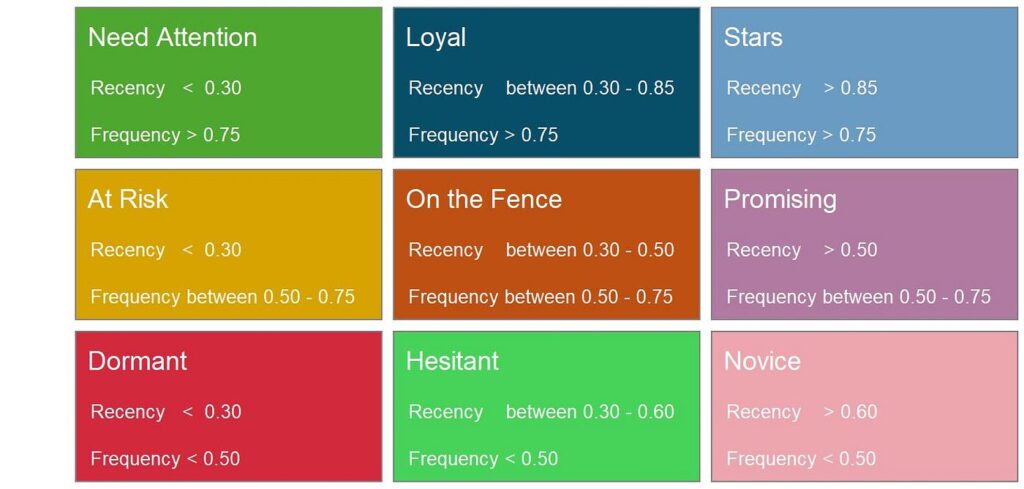
RFM segmentation is a powerful technique used by businesses to categorize customers based on their behavior and purchase patterns. RFM stands for Recency, Frequency, and Monetary value, which are key indicators of a customer’s relationship with a business. By creating RFM segments with SQL, businesses can analyze customer data to identify valuable segments, tailor marketing strategies, and drive personalized interactions. In this guide, we will discuss how to utilize SQL queries to calculate RFM scores and segment customers effectively for targeted marketing campaigns.
RFM segmentation is a powerful marketing analysis tool that helps businesses better understand their customers by focusing on three key metrics: Recency, Frequency, and Monetary value. In this guide, we will explore how to create RFM segmentation using SQL, breaking down the process step-by-step to help you gather insights effectively.
Understanding RFM Segmentation
Before diving into the SQL queries, it’s essential to understand what RFM stands for:
- Recency
- Frequency: How often a customer makes a purchase within a defined period.
- Monetary: How much money a customer spends over a specified time frame.
Using these three metrics, businesses can categorize customers into segments, allowing for targeted marketing strategies that bore higher conversion rates. SQL offers robust capabilities for analyzing transactional data to derive RFM insights.
Gathering the Data
To create RFM segmentation, begin by gathering your data. You’ll want to have a transactions table that includes details such as:
- Customer ID
- Transaction Date
- Transaction Amount
Your data might be structured like this:
CREATE TABLE transactions (
    customer_id INT,
    transaction_date DATE,
    amount DECIMAL(10, 2)
);
Calculating Recency, Frequency, and Monetary Value
The next step in RFM segmentation is to calculate the RFM metrics. Below are the SQL queries for each component.
1. Recency Calculation
To calculate Recency, determine the number of days since the last purchase for each customer. Use the following SQL query:
SELECT customer_id,
       DATEDIFF(CURRENT_DATE, MAX(transaction_date)) AS recency
FROM transactions
GROUP BY customer_id;
2. Frequency Calculation
For Frequency, count the number of transactions made by each customer over a specified period:
SELECT customer_id,
       COUNT(*) AS frequency
FROM transactions
GROUP BY customer_id;
3. Monetary Value Calculation
To find the Monetary value, sum the total transaction amounts for each customer:
SELECT customer_id,
       SUM(amount) AS monetary_value
FROM transactions
GROUP BY customer_id;
Combining RFM Metrics
Once you have calculated the individual RFM metrics, the next step is to combine them into a single table. You can achieve this by using a JOIN operation.
SELECT r.customer_id,
       r.recency,
       f.frequency,
       m.monetary_value
FROM (SELECT customer_id,
             DATEDIFF(CURRENT_DATE, MAX(transaction_date)) AS recency
      FROM transactions
      GROUP BY customer_id) AS r
JOIN (SELECT customer_id,
             COUNT(*) AS frequency
      FROM transactions
      GROUP BY customer_id) AS f
ON r.customer_id = f.customer_id
JOIN (SELECT customer_id,
             SUM(amount) AS monetary_value
      FROM transactions
      GROUP BY customer_id) AS m
ON r.customer_id = m.customer_id;
Scoring the RFM Metrics
After obtaining the RFM table, the next vital step is to score each metric. Assign scores based on quantiles to categorize customers into segments. Here’s a simplified example of how you might score these metrics:
WITH rfm AS (
    SELECT customer_id,
           recency,
           frequency,
           monetary_value,
           NTILE(5) OVER(ORDER BY recency) AS recency_score,
           NTILE(5) OVER(ORDER BY frequency DESC) AS frequency_score,
           NTILE(5) OVER(ORDER BY monetary_value DESC) AS monetary_score
    FROM (
        SELECT r.customer_id,
               r.recency,
               f.frequency,
               m.monetary_value
        FROM (SELECT customer_id,
                     DATEDIFF(CURRENT_DATE, MAX(transaction_date)) AS recency
              FROM transactions
              GROUP BY customer_id) AS r
        JOIN (SELECT customer_id,
                     COUNT(*) AS frequency
              FROM transactions
              GROUP BY customer_id) AS f
        ON r.customer_id = f.customer_id
        JOIN (SELECT customer_id,
                     SUM(amount) AS monetary_value
              FROM transactions
              GROUP BY customer_id) AS m
        ON r.customer_id = m.customer_id
    ) AS rfm_data
)
SELECT customer_id,
       recency,
       frequency,
       monetary_value,
       recency_score + frequency_score + monetary_score AS rfm_score
FROM rfm;
Segmenting Customers Based on RFM Scores
Once you have the RFM scores, you can segment customers into distinct categories. Common segments include:
- Champions: Customers with high Recency, Frequency, and Monetary scores.
- Potential Loyalists: Customers with high Frequency and Monetary scores but lower Recency.
- At Risk: Customers with high Recency scores indicating they haven’t purchased recently, but they used to spend significantly.
- Lost Customers: Customers who have not made any transactions in a long period.
Utilizing SQL, you can create detailed segments to identify targeted marketing strategies for each group. Here’s an example SQL query for segmentation:
SELECT customer_id,
       CASE
           WHEN rfm_score >= 12 THEN 'Champions'
           WHEN rfm_score BETWEEN 9 AND 11 THEN 'Potential Loyalists'
           WHEN rfm_score BETWEEN 5 AND 8 THEN 'At Risk'
           ELSE 'Lost Customers'
       END AS segment
FROM (
    SELECT customer_id,
           recency,
           frequency,
           monetary_value,
           recency_score + frequency_score + monetary_score AS rfm_score
    FROM rfm
) AS segmented_rfm;
Visualizing RFM Segmentation
To make your data insights even more actionable, you might want to visualize the RFM segments. While SQL is primarily a data handling tool, exporting your results to a business intelligence tool like Tableau, Power BI, or Google Data Studio can enhance the understanding of your RFM analysis.
By following the above steps, you can create effective RFM segmentation using SQL, allowing your business to make data-driven marketing decisions. Using SQL for RFM analysis can greatly improve your ability to target specific customer segments and ultimately drive sales growth.
Implementing RFM segmentation with SQL can greatly benefit businesses by providing valuable insights into customer behavior and identifying high-value segments for targeted marketing strategies. By utilizing RFM analysis, companies can enhance customer engagement, drive personalized marketing campaigns, and ultimately increase profitability and customer satisfaction.
Related posts:
 The SELECT Statement: How to Retrieve Data from a Table
 Using WHERE to Filter Data Effectively
 How to Use ORDER BY to Sort Query Results
 The DELETE Command: Removing Records from SQL Tables
 Understanding Primary Keys and Foreign Keys
 Common Data Types in SQL Explained
 Table Relationships: One-to-One, One-to-Many, Many-to-Many
 Differences Between INNER JOIN, LEFT JOIN, RIGHT JOIN, and FULL JOIN
 Grouping Data with GROUP BY
 Comparison Operators: =, <>, >, <, >=, <=
 Logical Operators: AND, OR, NOT
 Subqueries: When and How to Use Them
 Correlated vs. Non-Correlated Subqueries
 What is a Self Join and How to Use It?