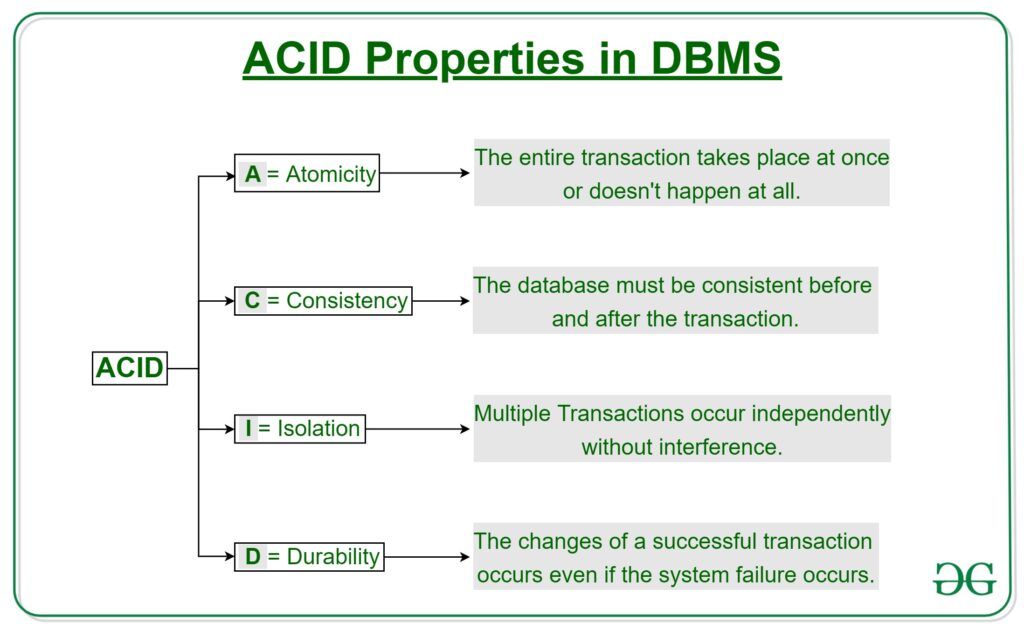
In the realm of database management systems, ACID properties play a vital role in ensuring data integrity and consistency. ACID stands for Atomicity, Consistency, Isolation, and Durability, and these four properties are essential for maintaining the reliability of transactions in SQL databases. Understanding ACID properties is crucial for developers and database administrators to design and implement robust systems that can handle concurrent transactions effectively. This introduction will delve into each ACID property in detail, explaining their significance and impact on transaction management in SQL databases.
ACID properties are fundamental principles that ensure reliable processing of database transactions in the SQL (Structured Query Language) database environment. Understanding these properties is crucial for anyone working with databases, as they guarantee the integrity and consistency of data throughout various operations. This article delves into the four key components of the ACID properties: Atomicity, Consistency, Isolation, and Durability.
What are ACID Properties?
The term ACID is an acronym representing four essential properties of transactions in a database management system (DBMS). These properties collectively enhance the reliability of database operations:
- Atomicity
- Consistency
- Isolation
- Durability
Let’s explore each of these properties in more detail:
1. Atomicity
Atomicity refers to the all-or-nothing principle of database transactions. When a transaction is executed, it is treated as a single unit of work. This means that either all operations within the transaction are completed successfully, or none of them are. For example, consider a banking application that transfers money from one account to another. The transaction must include both debiting the amount from one account and crediting it to the other. If any part of this process fails, the entire transaction is rolled back, ensuring that the database remains in a consistent state.
Atomicity is crucial for preventing partial transactions that could lead to data inconsistency. Various techniques, such as transaction logs and two-phase commit protocols, are used to implement this property effectively.
2. Consistency
Consistency ensures that a transaction takes the database from one valid state to another valid state, maintaining all predefined rules, constraints, and relationships. This property guarantees that any data written to the database must be valid according to all defined rules, including primary keys, foreign keys, and other integrity constraints.
For example, if a constraint exists that prevents users from having negative account balances, any transaction that attempts to violate this rule will be rolled back. Thus, consistency helps maintain the integrity and accuracy of data across the database system.
3. Isolation
Isolation deals with the concurrent execution of transactions in a multi-user environment. It ensures that the execution of one transaction does not interfere with the execution of another. This property is essential for systems that handle multiple transactions simultaneously, as it helps protect the integrity of data from concurrent transaction conflicts.
Isolation can be implemented through various locking mechanisms, such as shared locks and exclusive locks. Different levels of isolation, defined as isolation levels, allow systems to balance between performance and data integrity. The common levels of isolation include:
- Read Uncommitted
- Read Committed
- Repeatable Read
- Serializable
Each level offers a different trade-off between concurrency and consistency. For instance, Serializable is the strictest level and ensures complete isolation but may lead to reduced performance due to the stringent locking required.
4. Durability
Durability refers to the guarantee that once a transaction has been committed, it will remain so, even in the event of a system failure or crash. This means that the effects of a successful transaction are permanently recorded in the database, ensuring that data is not lost.
Durability is achieved through various means, such as transaction logs and backup systems. When a transaction is completed, it is logged to ensure that it can be recovered in case of a failure or crash. Implementing durability not only protects data integrity but also instills confidence in users regarding the reliability of the database.
Real-World Applications of ACID Properties
Banking Transactions
In the banking sector, transactions such as fund transfers must adhere strictly to ACID properties. Inconsistent results, like an account being debited without corresponding crediting to another account, can lead to severe financial discrepancies.
E-commerce Platforms
In e-commerce applications, the integrity of transaction data is crucial. When customers place orders, the system must ensure that stock levels are accurately updated and that payment transactions are atomic to prevent overselling products.
Healthcare Systems
For healthcare applications, ACID properties protect sensitive patient data during operations, ensuring accurate records during crucial transactions such as medical billing or sterilization of inventory.
ACID vs. BASE
While ACID properties are fundamental to traditional RDBMS (Relational Database Management Systems), many modern applications have shifted to NoSQL databases that sometimes implement a different model known as BASE (Basically Available, Soft state, Eventually consistent).
BASE is more relaxed compared to ACID, offering better performance and scalability while sacrificing some level of consistency. It allows for a model where the system is always available, even if some data may temporarily be inconsistent.
Understanding the differences between these approaches is essential for database architects and developers to select the appropriate model based on the demands of their applications.
Best Practices for Managing ACID Properties
To effectively manage ACID properties within your SQL database, consider adopting these best practices:
- Utilize Transactions – Always wrap your database operations within transactions to ensure atomicity.
- Implement Constraints – Define primary and foreign key constraints to maintain consistency in your data model.
- Choose the Right Isolation Level – Adjust the isolation level based on the needs of your application to balance performance and consistency.
- Make Use of Backup and Recovery Systems – Ensure that you have robust backup solutions in place to achieve durability.
Understanding ACID properties is essential for anyone working with SQL databases. By adhering to these principles, developers can ensure data integrity, accuracy, and reliability across transactions, ultimately leading to trustworthy applications and systems. Knowledge of ACID properties also equips database professionals to make informed decisions regarding database design, implementation, and maintenance.
Understanding the ACID properties in SQL – Atomicity, Consistency, Isolation, and Durability – is crucial for ensuring data integrity and reliability in database transactions. By adhering to these principles, developers can design robust, secure, and efficient database systems that meet the demands of modern applications and users.
Related posts:
 The SELECT Statement: How to Retrieve Data from a Table
 Using WHERE to Filter Data Effectively
 How to Use ORDER BY to Sort Query Results
 The DELETE Command: Removing Records from SQL Tables
 Understanding Primary Keys and Foreign Keys
 Common Data Types in SQL Explained
 Table Relationships: One-to-One, One-to-Many, Many-to-Many
 Differences Between INNER JOIN, LEFT JOIN, RIGHT JOIN, and FULL JOIN
 Grouping Data with GROUP BY
 Comparison Operators: =, <>, >, <, >=, <=
 Logical Operators: AND, OR, NOT
 Subqueries: When and How to Use Them
 Correlated vs. Non-Correlated Subqueries
 What is a Self Join and How to Use It?