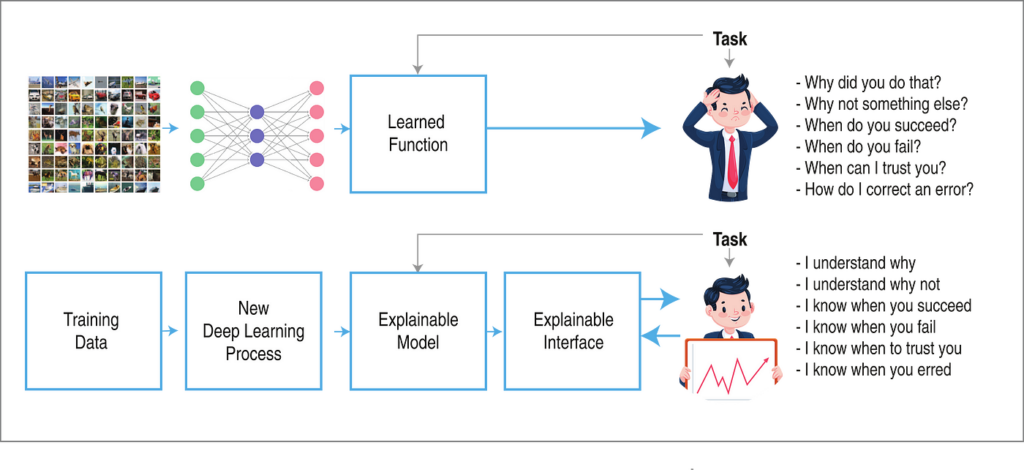
As the field of artificial intelligence continues to advance, the development of large-scale AI models has become increasingly prevalent. These models, powered by vast amounts of data, have shown remarkable capabilities in various applications such as natural language processing, image recognition, and decision-making. However, the inherent complexity of these deep learning models raises concerns regarding their explainability and transparency. In this context, the future of explainable deep learning in large-scale AI models is crucial for ensuring trust, accountability, and ethical compliance in AI systems. This article will explore the challenges and opportunities of achieving explainability in big data-driven AI models, and how this emerging field can shape the future of AI applications.
As artificial intelligence (AI) continues to revolutionize various sectors, the need for explainability in deep learning models has become increasingly evident. The complexity of these large-scale AI models poses challenges in understanding routine operations and decision-making processes. This article explores the advancements and potential future developments in explainable deep learning (XDL) and how they relate to big data.
Understanding Explainable Deep Learning
Explainable Deep Learning refers to methods and techniques designed to provide interpretations of the decisions made by AI models, especially deep learning systems that are inherently black-box in nature. As large-scale AI models like transformers and neural networks gain traction, the demand for transparency in AI is becoming more pronounced.
These models are adept at processing massive datasets and extracting insights; however, their decisions often lack the transparency essential for trust and accountability. As organizations increasingly rely on AI for critical decision-making, the implications of using black-box models can lead to ethical concerns, compliance-related issues, and a lack of trust from users.
The Importance of Explainability in AI
The significance of AI explainability can be categorized into several key areas:
- Trust and Accountability: Users and stakeholders are more likely to trust AI systems if they can understand how decisions are made.
- Regulatory Compliance: Many sectors face regulations that mandate transparency in AI usage, making explainability not just a preference but a necessity.
- Error Analysis and Debugging: Understanding model decisions aids in identifying errors, allowing developers to fine-tune their models for enhanced performance.
- Mitigating Bias: Explainable AI can help uncover biases within training data, allowing organizations to take corrective action to ensure fairness in AI-driven outcomes.
Current Trends in Explainable Deep Learning
The landscape of explainable deep learning is rapidly evolving, with several new trends gaining momentum:
1. Interpretable Neural Networks
Researchers are focusing on designing neural networks that inherently provide interpretable outputs. Techniques such as attention mechanisms allow users to pinpoint which features played crucial roles in a model’s decision, thereby increasing its interpretability.
2. Post-hoc Explanation Methods
Methods like LIME (Local Interpretable Model-agnostic Explanations) and SHAP (SHapley Additive exPlanations) have gained prominence for their ability to provide explanations for pretrained models. These techniques simulate local approximations of model behavior to elucidate why particular predictions are made.
3. User-Centric Explanations
As organizations recognize that different users require varied explanation formats, there is a growing emphasis on user-centric explanations. For example, domain experts might prefer intricate details, while end-users may favor simpler summaries. This adaptability is crucial for ensuring effective communication and understanding.
The Role of Big Data in Explainable Deep Learning
Big data plays a critical role in enhancing explainable deep learning by providing vast datasets for training models, leading to improved performance and insights. Here are a few ways big data facilitates explainability:
1. More Robust Training Datasets
Large volumes of diverse data enable models to learn complex patterns. With more comprehensive datasets, models can produce more reliable and generalizable explanations. Insights derived from big data can illuminate patterns that are essential for interpretability.
2. Enhanced Feature Selection
Leveraging big data technologies allows for better feature engineering and selection. By analyzing large datasets, researchers can identify which features are most informative, thus refining their focus on the elements that contribute significantly to the decision-making process.
3. Real-Time Insights
The integration of big data analytics with explainable AI frameworks leads to real-time insights. Organizations can continuously monitor model performance and obtain instant explanations of decisions, thus enhancing transparency and trust.
Challenges in Implementing Explainable Deep Learning
While the future of explainable deep learning looks promising, several challenges remain:
1. Trade-offs Between Performance and Interpretability
Often, more complex models yield better performance but at the cost of interpretability. Striking the right balance between a model’s accuracy and its explainability is a nuanced challenge that researchers are continually navigating.
2. Domain-Specific Interpretability
Different sectors have unique requirements for explainability. For instance, healthcare applications may demand a higher level of transparency compared to marketing models. Developing frameworks that cater to specific industry needs while ensuring broader applicability is an ongoing challenge.
3. Standardization of Evaluation Metrics
Currently, there is no universal standard for evaluating the explainability of deep learning models. The absence of agreed-upon metrics can hinder the widespread adoption of these explainability techniques across various domains.
The Future Prospects of Explainable Deep Learning
Looking ahead, several innovative trajectories may shape the future of explainable deep learning in connection with big data:
1. Integration with Knowledge Graphs
Combining explainable deep learning with knowledge graphs can facilitate richer explanations. Knowledge graphs help contextualize the data by establishing relationships, which augments the model’s insights and provides a clearer rationale behind decisions.
2. Explainability in Federated Learning
As federated learning becomes more prevalent, the demand for explainability in decentralized models will grow. Understanding decisions made by models trained on localized data without centralizing data can present unique challenges and opportunities.
3. Quantum Computing and Explainability
With quantum computing on the rise, the potential for enhanced AI models and their explainability might be realized. Quantum algorithms could enable faster processing and more sophisticated models that still prioritize explainability in their architectures.
4. Collaboration Between AI and Domain Experts
Involving domain experts in the interpretability process will enhance the relevance and usability of AI explanations. Collaboration will yield insights that blend technical knowledge with real-world applications, resulting in more effective models.
Conclusion: A Road Ahead for Explainable Deep Learning
The future of explainable deep learning is inextricably linked to big data. As models become increasingly complex, the need for transparency will only grow. Emphasizing explainability will facilitate trust and accountability in AI solutions while fostering safe and ethical usage across industries. Advancements in methodologies and an emphasis on user-centric designs will be critical to navigating the evolving landscape of AI. By addressing current challenges and exploring innovative technologies, the potential for explainable deep learning is vast and promising.
The future of explainable deep learning in large-scale AI models within the realm of Big Data holds tremendous potential for enhancing transparency, accountability, and trust in AI systems. By bridging the gap between complex model computations and human-understandable explanations, researchers and practitioners can unlock the full value of Big Data while ensuring ethical and responsible deployment of AI technologies. As advancements continue to be made in this field, the synergy between explainable deep learning and large-scale AI models will steer us towards a more interpretable and reliable future in the era of Big Data.
Related posts:
 Understanding Data Pipelines in Big Data
 What is Apache Hadoop? A Complete Guide
 Introduction to NoSQL Databases for Big Data
 Understanding HBase: How it Works in the Hadoop Ecosystem
 Natural Language Processing (NLP) with Big Data
 How Big Data is Used in Deep Learning Applications
 Sentiment Analysis with Big Data and AI
 Big Data in Smart Cities: Applications and Challenges
 Big Data and Retail: How It’s Changing the Shopping Experience
 Big Data in Agriculture: Precision Farming and Analytics
 What is Predictive Analytics in Big Data?
 Data Science vs. Big Data Analytics: Key Differences
 Data Partitioning Strategies for Big Data Scalability
 The Importance of Data Governance in Big Data