In the realm of Big Data analytics, achieving accurate and reliable results often hinges on the quality and balance of the dataset being analyzed. However, imbalanced datasets, where certain classes or categories are underrepresented, can pose a significant challenge. This is where the Synthetic Minority Over-Sampling Technique (SMOTE) comes into play. SMOTE is a powerful algorithm widely used in Big Data applications to address imbalanced datasets by generating synthetic examples of the minority class to rebalance the dataset. By intelligently creating new instances through interpolation, SMOTE not only helps improve the performance of machine learning models, but also enhances the overall robustness and interpretability of Big Data analytics. In this article, we delve into the pivotal role that SMOTE plays in handling imbalanced datasets within the context of Big Data analytics, and explore its implications for data-driven decision-making in modern times.
The Synthetic Minority Over-sampling Technique (SMOTE) is a pivotal method in the field of Big Data analytics, especially when dealing with imbalanced datasets. In many real-world applications, the data we collect is not evenly distributed among various classes. This imbalance can significantly skew the decision-making process of predictive models, making techniques like SMOTE essential for improving the quality of insights derived from Big Data.
Understanding Imbalanced Datasets
An imbalanced dataset occurs when one class of instances significantly outnumbers another class. For example, in fraud detection, the number of legitimate transactions can far exceed the number of fraudulent ones. This kind of distribution can lead to biased model predictions, where the model can achieve high accuracy simply by predicting the majority class. Therefore, addressing this imbalance is critical when constructing reliable machine learning models on large datasets.
SMOTE: A Brief Overview
Developed in 2002 by Nitesh V. Chawla and his colleagues, SMOTE is an advanced oversampling technique designed to create synthetic samples of the minority class. It works on the principle of generating new, synthetic examples in the feature space, which helps the model learn from a more balanced dataset.
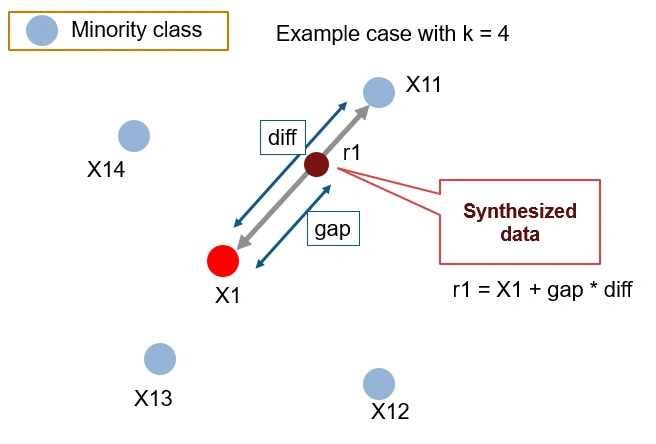
Unlike traditional random oversampling, which simply duplicates existing minority class instances, SMOTE derives its samples based on feature proximity. By computing the nearest neighbors of the minority class instances and interpolating between them, SMOTE crafts new instances that are not just simple copies but rather incorporate variations that may be present in real-world scenarios.
How SMOTE Works
Here’s a step-by-step breakdown of how SMOTE operates:
- Select a Minority Class Instance: For each instance of the minority class, SMOTE selects one or more of its nearest neighbors (usually using Euclidean distance).
- Interpolation: It generates a synthetic instance by interpolating between the feature space of the minority instance and one of its nearest neighbors. This is calculated by taking the difference between the two instances, multiplying by a random number between 0 and 1, and adding it to the minority class instance.
- Repeat: Steps 1 and 2 are repeated until the desired balance between the majority and minority class instances is achieved.
Advantages of Using SMOTE in Big Data
Implementing SMOTE in Big Data applications has several advantages:
1. Enhanced Model Performance
By addressing class imbalance, SMOTE helps create more robust predictive models. It reduces the likelihood of models being biased toward the majority class, thereby increasing the precision, recall, and overall accuracy of the model.
2. Improved Generalization
As SMOTE generates synthetic samples, the model gets exposed to a broader spectrum of the minority class. This diversity leads to better generalization and better performance on unseen data.
3. Adaptability
SMOTE can be easily adapted to various algorithms, including decision trees, random forests, and support vector machines (SVMs). This flexibility allows data scientists to leverage SMOTE across different projects and datasets effectively.
SMOTE Variants and Their Applications
Over time, several variants of SMOTE have been developed to address specific challenges. These include:
1. Borderline SMOTE
In Borderline SMOTE, the focus is on the minority instances that lie on the edge of the decision boundary. This method generates synthetic samples around these critical instances, making it particularly effective when the minority class overlap occurs significantly with the majority class.
2. SMOTE-ENN (Edited Nearest Neighbors)
SMOTE-ENN combines SMOTE with a cleaning process, where it removes instances that can be misclassified by a k-nearest neighbor classifier. This hybrid approach helps in reducing noise and outlier influence.
3. Adaptive Synthetic Sampling (ADASYN)
ADASYN extends the concept of SMOTE by generating more synthetic data for minority instances that are harder to learn. This adaptability allows it to focus on instances that are more difficult for the model, improving performance on complex datasets.
Challenges of Implementing SMOTE in Big Data
While SMOTE offers numerous benefits, it is not without challenges:
1. Computational Complexity
As Big Data grows, so does the computational load of calculating nearest neighbors for all instances. This can lead to increased processing times, requiring efficient implementation strategies.
2. Risk of Overfitting
By generating too many synthetic samples, especially when working with small datasets, there is a risk of overfitting the model to learn noise rather than genuine patterns in the data.
3. Quality of Nearest Neighbors
The effectiveness of SMOTE heavily relies on the choice of distance metric used to find nearest neighbors. In high-dimensional spaces, distance calculations can become less reliable due to the curse of dimensionality.
Best Practices for Implementing SMOTE
To maximize the effectiveness of SMOTE while minimizing its drawbacks, consider the following best practices:
1. Data Preprocessing
Before applying SMOTE, ensure that the dataset is appropriately cleaned and preprocessed. This includes handling outliers, missing values, and selecting relevant features to reduce noise and improve the quality of the synthesized samples.
2. Use Cross-Validation
Implement cross-validation techniques to evaluate the model performance accurately. This helps ensure that the model built using SMOTE performs well on unseen data while avoiding overfitting.
3. Experiment with Different Variants
Don’t limit yourself to standard SMOTE. Test various SMOTE variants to see which combination of synthetic sampling techniques offers the best model performance for the specific dataset you’re dealing with.
4. Monitor the Impact
Continuously monitor the impact of SMOTE on your models. Comparing performance metrics before and after the application of SMOTE can provide insights into whether it’s beneficial or if alternative techniques should be deployed.
Conclusion: SMOTE’s Critical Role in Big Data Analytics
In the realm of Big Data analytics, the Synthetic Minority Over-sampling Technique (SMOTE) is not merely a tool but a critical component in addressing the challenges of imbalanced datasets. By allowing practitioners to create balanced datasets through synthetic sampling, SMOTE enhances model training and leads to better decision-making in various applications ranging from health informatics to fraud detection in financial systems. Its adaptability, coupled with its various enhancements, makes it an essential technique for data scientists in the Big Data landscape.
Synthetic Minority Over-Sampling Technique (SMOTE) plays a crucial role in improving the performance of machine learning models in handling imbalanced datasets within the realm of Big Data analytics. By generating synthetic examples for minority class data points, SMOTE aids in enhancing the accuracy and reliability of predictive modeling, ultimately contributing to more robust and effective data-driven decision-making processes.
Related posts:
 Understanding Data Pipelines in Big Data
 What is Apache Hadoop? A Complete Guide
 Introduction to NoSQL Databases for Big Data
 Understanding HBase: How it Works in the Hadoop Ecosystem
 Natural Language Processing (NLP) with Big Data
 How Big Data is Used in Deep Learning Applications
 Sentiment Analysis with Big Data and AI
 Real-Time AI and Big Data: How It Works
 The Impact of Big Data on Financial Services and Banking
 Big Data in Smart Cities: Applications and Challenges
 Big Data and Retail: How It’s Changing the Shopping Experience
 Big Data in Agriculture: Precision Farming and Analytics
 What is Predictive Analytics in Big Data?
 Data Science vs. Big Data Analytics: Key Differences