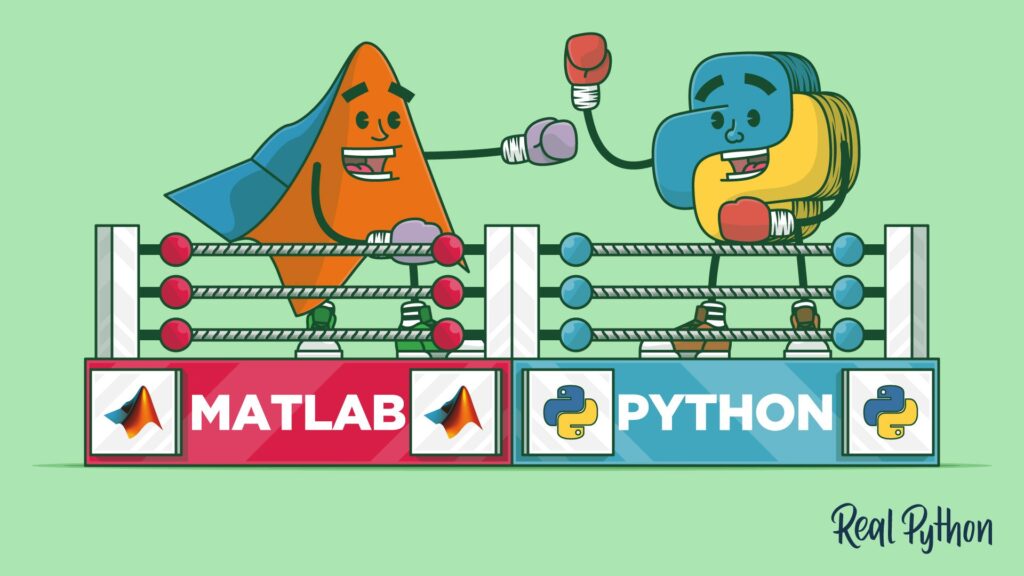
MATLAB’s biggest competitor is probably Python. Python is a versatile and widely-used programming language that offers similar capabilities to MATLAB in terms of data analysis, visualization, and numerical computing. Python has a strong presence in the scientific and engineering communities due to its ease of use, extensive library support, and open-source nature, making it a popular choice for those seeking an alternative to MATLAB.
When it comes to technical computing and programming, MATLAB has established itself as a popular and dominant player in the field. However, there are several competitive software options available that challenge MATLAB’s supremacy. In this article, we will explore the top alternatives to MATLAB, giving you an insight into the competing software and their capabilities.
1. Python with NumPy and SciPy
One of the most powerful contenders to MATLAB’s throne is Python, along with its scientific libraries NumPy and SciPy. Python is an open-source programming language known for its simplicity and readability. It offers a wide range of libraries specifically designed for scientific computation.
NumPy provides robust support for numerical operations, including linear algebra, Fourier transforms, and random number generation. On the other hand, SciPy extends the functionality of NumPy with additional tools for optimization, statistics, signal processing, and more.
Python’s popularity has soared in recent years due to its versatility and the extensive support from the developer community. It also has a rich ecosystem of libraries and frameworks, making it an ideal choice for scientific computing.
2. R
R is another prominent player in the world of data analysis and statistical computing. It is a programming language specifically designed for statistical computing and graphics. Its syntax is slightly different from MATLAB, but it offers a wide range of packages and libraries for data manipulation, visualization, and statistical modeling.
R provides an extensive set of tools for statistical analysis, including regression, hypothesis testing, and machine learning. Its graphics capabilities are particularly impressive, with a wide variety of plotting and visualization options.
One of the advantages of R is its active community, which continuously contributes to the development of new packages and extensions. It has gained popularity in academia and industries that heavily rely on statistical analysis.
3. Julia
Julia is a relatively newer programming language that has gained attention for its speed and ease of use. It is designed for high-performance numerical analysis and scientific computing. Julia provides a syntax that is similar to MATLAB, making the transition between the two relatively smooth.
Julia boasts impressive performance benchmarks, giving it an edge over some of its competitors. It supports parallel and distributed computing, making it suitable for computationally intensive tasks. Julia’s built-in support for multiple dispatch allows for efficient handling of complex operations.
Furthermore, Julia has a growing package ecosystem that covers a wide range of applications, including optimization, differential equations, and machine learning. Its active community ensures regular updates and improvements.
4. GNU Octave
GNU Octave is an open-source alternative to MATLAB, providing a similar interface and compatibility with MATLAB code. It aims to be a free alternative that retains the core functionality of MATLAB while evading the associated costs.
GNU Octave offers a high-level programming language with extensive support for solving linear and nonlinear problems, performing numerical experiments, and implementing algorithms. It provides a command-line interface and supports scripting, making it suitable for both interactive use and large-scale automation.
While it may not have all the advanced features of MATLAB, GNU Octave can be an excellent choice for users who need the main functionality of MATLAB without the associated licensing fees.
5. Scilab
Scilab is another open-source alternative to MATLAB that mirrors much of MATLAB’s functionality. It offers a high-level programming language and a strong set of mathematical computation tools.
Scilab has a user-friendly interface, making it easy to learn and use. It supports a wide range of mathematical operations and provides numerous toolboxes for various domains, such as control systems, signal processing, and optimization.
One notable advantage of Scilab is its compatibility with MATLAB code. This allows users to seamlessly migrate their MATLAB projects to Scilab with minimal modifications.
While MATLAB remains a dominant force in technical computing, there are several competitive software options challenging its supremacy. Python with NumPy and SciPy, R, Julia, GNU Octave, and Scilab are among the top alternatives to MATLAB.
Each alternative has its own unique strengths and areas of specialization. Python stands out with its vast ecosystem and versatility, R excels in statistical computing and graphics, Julia emphasizes performance, GNU Octave provides MATLAB compatibility at no cost, and Scilab offers a user-friendly interface.
When choosing the right software for your needs, it is essential to consider your specific requirements, compatibility with existing workflows, and the support and resources available for each alternative. Ultimately, the best alternative to MATLAB will depend on your preferences and the nature of your computational tasks.
While there are several competitors in the market, one of MATLAB’s biggest competitors is Python. Python offers similar capabilities in data analysis, scientific computing, and machine learning, making it a popular alternative among researchers and developers. Ultimately, the choice between MATLAB and Python depends on individual preferences, project requirements, and familiarity with each programming language.
Related posts:
 What is the MATLAB used for?
 Is MATLAB similar to Python?
 Is MATLAB written in C or C++?
 Can MATLAB use Python?
 Is MATLAB free to use?
 Is MATLAB difficult to learn?
Should I learn Python or MATLAB?
Can Python fully replace MATLAB?
Is MATLAB difficult to learn?
Should I learn Python or MATLAB?
Can Python fully replace MATLAB?
 Why is MATLAB still used?
What language is close to MATLAB?
Does MATLAB count as coding?
Why is MATLAB still used?
What language is close to MATLAB?
Does MATLAB count as coding?
 How long does it take to learn MATLAB?
 Why do engineers use MATLAB instead of Python?
 What is better than MATLAB?