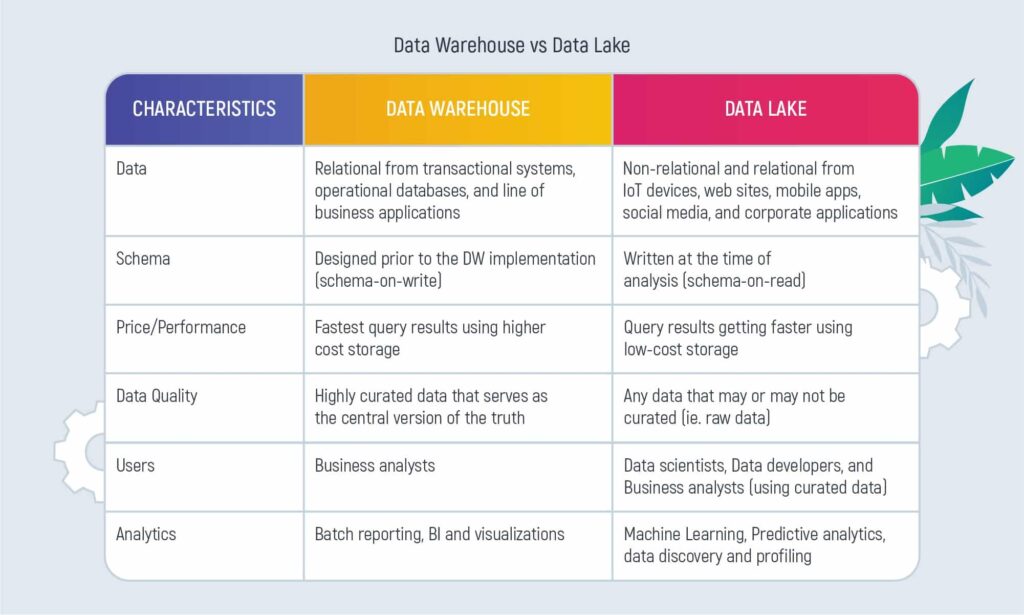
In the realm of Big Data management, two prominent solutions have emerged as keystones for storing and analyzing vast amounts of data: Data Lakes and Data Warehouses. Each solution offers unique advantages and drawbacks. Data Lakes, characterized by their ability to store raw, unstructured data at scale, provide flexibility and cost-effectiveness. On the other hand, Data Warehouses excel at delivering high performance queries on structured data for business intelligence and reporting purposes. Understanding the pros and cons of Data Lakes and Data Warehouses is crucial for organizations seeking to effectively harness the power of Big Data for actionable insights and decision-making.
Understanding Data Lakes
A Data Lake is a centralized repository that allows you to store all structured and unstructured data at any scale. Designed to accommodate massive volumes of data, Data Lakes provide the flexibility to store raw data, which can later be processed and analyzed for various business purposes.
Key Features of Data Lakes
- Scalability: Data Lakes can easily accommodate growing data volumes, making them suitable for enterprises dealing with Big Data.
- Flexibility: They allow for the storage of various data types including text, videos, images, and more.
- Cost-Effectiveness: Using commodity hardware or cloud solutions decreases infrastructure costs.
- Schema-on-read: Data can be stored in its original format, and schema can be applied when data is read, facilitating easier data ingestion.
Pros of Data Lakes
1. Enhanced Accessibility: Data Lakes provide immediate access to a wide array of data formats and types, enabling analysts to conduct real-time data analysis.
2. Support for Advanced Analytics: Data Lakes are particularly suited for AI and machine learning applications, where vast amounts of data are required to derive meaningful insights.
3. Preservation of Raw Data: The ability to store unprocessed data preserves the original context, which can be valuable for future analytical needs.
4. Improved Collaboration: Data Lakes enable multiple teams across an organization to access and share data, fostering collaboration and innovation.
Cons of Data Lakes
1. Data Governance Issues: With the ease of data ingestion, maintaining data quality and consistency becomes a challenge. Lack of governance can lead to data chaos.
2. Performance Risks: Large unoptimized data sets can lead to slower processing times and may require complex frameworks for data retrieval.
3. Complexity in Management: Managing security, metadata, and data cataloging can become more complicated, requiring skilled personnel to operate effectively.
4. Potentially High Costs: While Data Lakes can be cost-effective, the infrastructure and tools to manage and secure them can lead to rising operational costs over time.
Understanding Data Warehouses
A Data Warehouse is a centralized repository designed to support business intelligence (BI) activities. Unlike Data Lakes, Data Warehouses store structured data that is often processed, cleaned, and organized for easy access by business users and analysts.
Key Features of Data Warehouses
- Structured Data Storage: Data Warehouses are optimized for storing and managing structured data from different operational systems.
- ETL Processes: They typically employ Extract, Transform, Load (ETL) processes, ensuring that data is cleaned, formatted, and organized before storage.
- High Performance: Data Warehouses are specifically built to facilitate complex queries and fast data retrieval, which is critical for timely decision-making.
- Data Consistency: They enforce data integrity and governance, ensuring consistent data across the organization.
Pros of Data Warehouses
1. Speed and Efficiency: Data Warehouses are particularly designed for high-speed analytics, allowing users to quickly retrieve data for decision-making.
2. Data Quality: With rigorous ETL processes in place, the data is cleaned and validated, ensuring quality and reliability.
3. Business Intelligence Optimization: Data Warehouses are tailored for BI tools, facilitating easy integration, reporting, and visualization.”
4. Improved Security: Data Warehouses typically have robust security measures in place, safeguarding sensitive business data.
Cons of Data Warehouses
1. Limited Data Types: Data Warehouses primarily deal with structured data, making them less flexible compared to Data Lakes when it comes to data variety.
2. Costly Implementation: The initial costs of setting up a Data Warehouse can be high, requiring significant investment in specialized hardware and software.
3. Rigid Structure: Data Warehouses require predefined schemas, meaning that any changes to data types or structures necessitate a complex redesign process.
4. Time-Consuming ETL Processes: The ETL process can be time-consuming and may delay data availability for users who need quick insights.
Choosing Between a Data Lake and a Data Warehouse
Deciding between a Data Lake and a Data Warehouse ultimately comes down to an organization’s specific needs and use cases. Here are some key considerations:
1. Type of Data
If an organization primarily deals with structured data and needs quick analytics, a Data Warehouse is likely the better choice. On the other hand, if they manage a significant amount of unstructured data or require raw data for advanced analytics, a Data Lake would be more suitable.
2. Analytics Requirements
For businesses aiming for complex analytical processes and real-time data insights, Data Lakes provide the necessary flexibility. However, for business intelligence reporting and standardized queries, Data Warehouses could be more efficient.
3. Budgetary Constraints
While Data Lakes often come with lower initial setup costs, ongoing management and security can drive costs up in the long run. Companies must assess their budget and operational needs to make an informed choice.
4. Data Governance and Compliance
Organizations with strict compliance regulations often favor Data Warehouses due to their inherent data quality standards, governance frameworks, and security measures.
5. Long-term Scalability
For companies anticipating significant data growth, Data Lakes offer extensive scalability and better support for diverse data types. Organizations must weigh their growth projections against potential costs and management complexities.
Hybrid Approaches
As businesses evolve and data needs become more complex, some organizations are opting for a hybrid approach, utilizing both Data Lakes and Data Warehouses. This allows them to harness the strengths of both systems:
- Data Lakes for Raw Data Storage: Organizations can utilize Data Lakes to collect and store all forms of data.
- Data Warehouses for Structured Data Processing: Processed and cleaned data can be moved to a Data Warehouse to facilitate efficient analysis and reporting.
This hybrid architecture not only combines the flexibility of Data Lakes with the performance of Data Warehouses but also provides a comprehensive ecosystem for managing and analyzing Big Data.
Conclusion
Ultimately, whether to choose a Data Lake or a Data Warehouse depends on the specific needs of your organization, the types of data you handle, and your analytics goals. By carefully assessing the pros and cons, businesses can create a data strategy that positions them for future success in an increasingly data-driven world.
Both Data Lakes and Data Warehouses play important roles in managing and analyzing data in the realm of Big Data. Data Lakes offer flexibility, scalability, and cost-effectiveness for storing and processing large volumes of raw and unstructured data. On the other hand, Data Warehouses provide structure, quick retrieval, and optimized querying for well-defined and processed data. While Data Lakes are ideal for exploratory analysis and handling diverse data sources, Data Warehouses are best suited for business intelligence and reporting needs. Therefore, leveraging both Data Lakes and Data Warehouses can create a comprehensive data ecosystem that meets the diverse requirements of Big Data analysis and decision-making.
Related posts:
 The Five Vs of Big Data: Volume, Velocity, Variety, Veracity, and Value
 Introduction to Distributed Computing in Big Data
 Understanding Data Pipelines in Big Data
 What is Apache Hadoop? A Complete Guide
 Understanding Apache Spark: Features and Use Cases
 Introduction to NoSQL Databases for Big Data
 Understanding HBase: How it Works in the Hadoop Ecosystem
 The Intersection of Big Data and Artificial Intelligence
 Natural Language Processing (NLP) with Big Data
 How Big Data is Used in Deep Learning Applications
 Sentiment Analysis with Big Data and AI
 Real-Time AI and Big Data: How It Works
 The Impact of Big Data on Financial Services and Banking
 Big Data in E-commerce: Personalization and Customer Insights