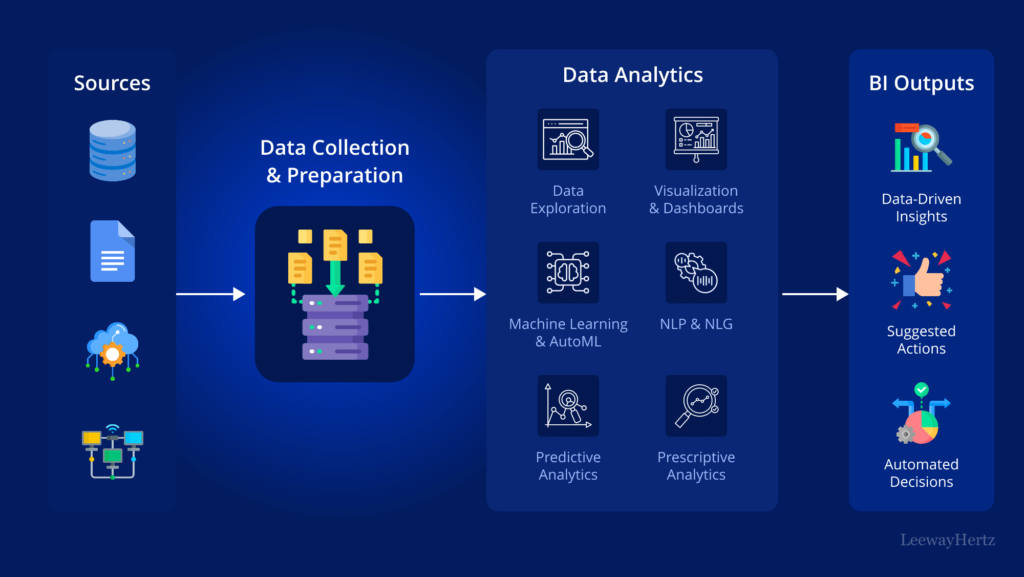
As the volume of data generated continues to skyrocket, businesses are increasingly turning to AI-driven Business Intelligence (BI) dashboards to glean valuable insights from their Big Data. These advanced tools leverage machine learning algorithms to process vast amounts of data quickly and accurately, enabling organizations to make data-driven decisions with speed and precision. In the future, AI-driven BI dashboards are poised to revolutionize the way businesses harness the power of Big Data, providing deeper, more actionable insights that drive competitive advantage and fuel innovation.
Understanding Business Intelligence Dashboards
Business Intelligence (BI) dashboards are interactive visualizations that aggregate data from multiple sources, enabling businesses to analyze and present key metrics through graphs, charts, and tables. As organizations generate vast amounts of big data, the need for effective data visualization tools becomes increasingly critical. These dashboards transform raw data into actionable insights, allowing decision-makers to grasp complex datasets quickly.
When enhanced by artificial intelligence (AI), BI dashboards can elevate data analysis by providing predictive insights, automating workflows, and personalizing user experiences. The future of BI dashboards will see a greater convergence of AI technologies, resulting in tools that are not only smarter but also more integral to operational strategies across industries.
The Role of AI in Enhancing BI Dashboards
AI introduces a wealth of functionalities that significantly enhance business intelligence dashboards. Some core roles include:
1. Advanced Data Processing
AI algorithms enable the processing of complex datasets at remarkable speed. This includes:
- Natural Language Processing (NLP): Users can interact with dashboards using simple spoken or written language, making data querying more intuitive.
- Automated ETL (Extract, Transform, Load): AI can streamline the ETL process, ensuring that data is clean, relevant, and timely.
2. Predictive and Prescriptive Analytics
Integrating AI with BI dashboards allows for the implementation of predictive analytics, which can forecast trends based on historical data. Furthermore:
- Prescriptive analytics will suggest actionable strategies based on predicted outcomes, allowing businesses to be proactive rather than reactive.
3. Enhanced Data Visualization
With AI, dashboards can provide more dynamic and intelligent visualizations that adapt based on user interactions and changes in data. This includes:
- Adaptive Dashboards: The display can evolve to highlight the most relevant metrics for users in real-time.
- Automated Insights: AI can describe anomalies or trends detected in the data, enhancing user understanding without needing extensive data analysis skills.
The Evolution of Business Intelligence Dashboards
The advancement of AI technologies means that the next generation of BI dashboards will be significantly more advanced than their predecessors. Some anticipated evolutions include:
1. Enhanced User Experience
In the future, user interfaces for BI dashboards will become increasingly user-friendly and tailored. Features will likely include:
- Customizable User Interfaces: Users will have the ability to customize their dashboards extensively, choosing which KPIs and data visualizations are most relevant to their tasks.
- Interactive Visualizations: Dashboards will allow users to drill down into data through interactive charts and graphs, providing a deeper exploration of insights.
2. Increased Integration Capabilities
Modern BI dashboards will integrate seamlessly with a range of other enterprise applications. This comprehensive connectivity will facilitate:
- Cross-Platform Data Sharing: Organizations can easily share and analyze data across different departments, breaking down silos.
- Real-Time Data Streaming: Integrations with IoT devices and live data feeds will enable real-time monitoring and insights, ensuring decisions are based on the most current data.
3. AI-Driven Data Discovery
Future BI dashboards will also facilitate AI-driven data discovery, where:
- Automated Data Correlation: AI will find patterns across disparate datasets, alerting users to insights they might not have noticed.
- Intelligent Recommendations: Dashboards may suggest additional data sources or metrics that could yield important insights.
The Impact of Big Data on Business Intelligence
The ever-growing volume and complexity of big data are driving the evolution of BI dashboards. Some implications include:
1. Data Governance and Quality Control
As businesses collect more data, the need for robust data governance strategies grows. Ensuring high-quality, accurate data is critical for effective BI. This involves:
- Automated Data Quality Checks: AI can automate the validation and cleaning of data to ensure reliability.
- Rigorous Access Controls: Protecting sensitive data while ensuring the right users have access to critical insights will need to be a priority.
2. Scalability and Flexibility
The architectural design of future BI systems must accommodate scalable solutions. This includes:
- Cloud-Based Solutions: With increasing data storage needs, cloud computing offers scalable infrastructure for BI applications.
- Modular Dashboard Features: Organizations can implement only the features they require, adapting their dashboard as needs change.
3. Enhanced Security Measures
As organizations become reliant on AI and big data, security is paramount. Future BI systems must have:
- End-to-End Encryption: Protecting data in transit and at rest will be vital.
- AI-Powered Threat Detection: Implementing AI to identify and mitigate security threats in real-time will enhance data safety.
Challenges Facing AI-Driven BI Dashboards
While the future looks promising, several challenges remain that organizations will need to address for successful implementations.
1. Data Privacy Concerns
With regulations like the GDPR and CCPA, businesses must prioritize data privacy when designing their BI dashboards to stay compliant while effectively utilizing big data.
2. Skills Gap and Training
The rapid evolution of AI and BI technologies will demand a workforce equipped with advanced skills. Businesses will need ongoing training programs to ensure team members are proficient in new tools and methodologies.
3. Managing Change
Transitioning to AI-driven BI solutions can meet resistance from employees accustomed to traditional methods. Therefore, promoting a culture of data literacy and change management will be essential.
Conclusion: The Path Ahead
The convergence of AI and business intelligence dashboards represents an exciting frontier for big data analytics. As technologies develop, businesses must remain agile, continuously adapting their strategies to leverage these advancements for data-driven decision-making. Organizations that embrace AI-driven BI dashboards early will position themselves as leaders in their industries, gaining a competitive edge in the data-centric marketplace.
The future of AI-driven business intelligence dashboards for Big Data holds immense potential to revolutionize decision-making processes by providing real-time insights, predictive analytics, and personalized recommendations. As organizations continue to grapple with growing data volumes, the integration of AI into BI dashboards will be crucial in unlocking valuable business insights, driving efficiency, and fostering innovation in the ever-evolving landscape of Big Data. Embracing this transformative technology will be instrumental in enabling businesses to stay competitive, agile, and data-driven in the digital age.
Related posts:
 The Five Vs of Big Data: Volume, Velocity, Variety, Veracity, and Value
 Introduction to Distributed Computing in Big Data
 Understanding Data Pipelines in Big Data
 What is Apache Hadoop? A Complete Guide
 Understanding Apache Spark: Features and Use Cases
 Introduction to NoSQL Databases for Big Data
 Understanding HBase: How it Works in the Hadoop Ecosystem
 The Intersection of Big Data and Artificial Intelligence
 Natural Language Processing (NLP) with Big Data
 How Big Data is Used in Deep Learning Applications
 Sentiment Analysis with Big Data and AI
 Real-Time AI and Big Data: How It Works
 The Impact of Big Data on Financial Services and Banking
 Big Data in Smart Cities: Applications and Challenges