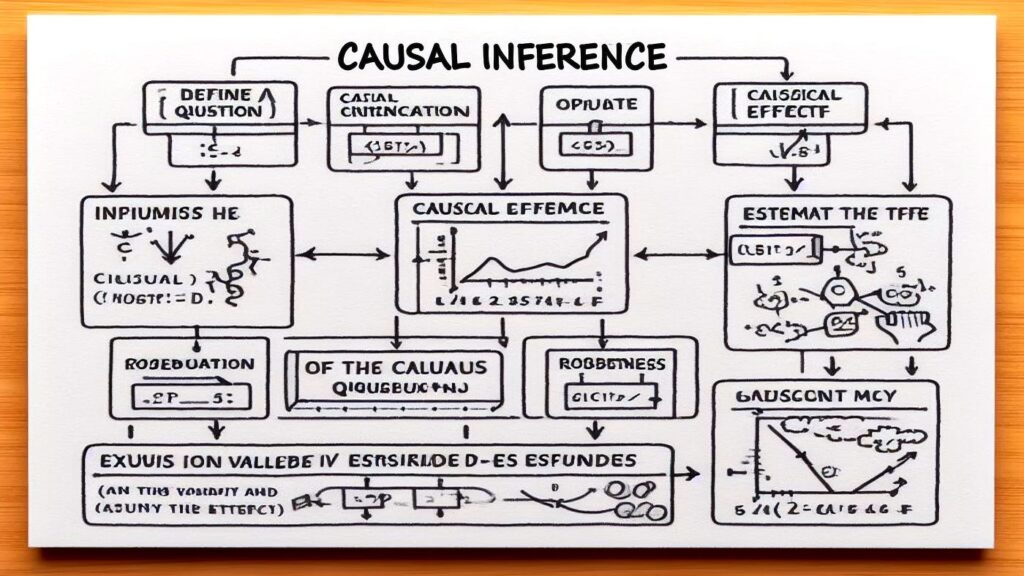
In the realm of Big Data analysis, the ability to draw causal inferences from data has a profound impact on decision-making processes. Causal inference involves understanding the cause-effect relationships between variables, allowing businesses and organizations to make more informed and strategic decisions based on data-driven insights. By harnessing the power of causal inference techniques in Big Data analysis, companies can uncover hidden patterns, predict outcomes more accurately, and optimize their decision-making processes for greater efficiency and effectiveness. This article explores the importance of causal inference in Big Data and its implications for driving data-driven decision-making strategies in the modern business landscape.
The growing field of Big Data analytics has transformed how businesses operate and make decisions. With the vast amounts of data generated every second, organizations are harnessing the power of causal inference to derive meaningful insights that drive strategic actions. In this article, we will explore the significant influence of causal inference on decision-making in the realm of Big Data, highlighting various methods, applications, and challenges.
Understanding Causal Inference
Causal inference is the process of determining whether a relationship between two variables is causal or merely correlational. It goes beyond traditional statistical methods that simply identify associations and seeks to answer questions about cause-and-effect relationships. In the context of Big Data, causal inference helps organizations make informed decisions based on a clearer understanding of how different factors influence outcomes.
For instance, in a marketing campaign, businesses want to know if a particular advertising strategy directly boosts sales or if other factors contribute to the observed increase. By applying causal inference techniques, organizations can isolate the effects of specific interventions, allowing them to optimize their strategies and allocate resources more effectively.
Methods for Implementing Causal Inference in Big Data
Several techniques are employed to conduct causal inference in Big Data. Some of the key methods include:
1. Randomized Controlled Trials (RCTs)
Randomized controlled trials are considered the gold standard for establishing causal relationships. By randomly assigning participants to different groups, researchers can control for confounding variables and isolate the effect of the treatment. While RCTs can be costly and impractical in certain settings, they remain a powerful tool for understanding causality.
2. Propensity Score Matching
Propensity score matching is a statistical technique used to control for confounding factors in observational studies. It involves estimating the probability that a unit (e.g., a customer, patient, etc.) receives a treatment based on observed characteristics. By matching treated and control groups based on their propensity scores, researchers can mimic the randomization process and assess the treatable effects more accurately.
3. Instrumental Variables
Instrumental variables (IV) are used when randomization is not possible, and endogeneity is a concern. An IV is a variable that is correlated with the treatment but not directly related to the outcome except through the treatment. By using IVs, researchers can uncover causal effects in the presence of unmeasured confounding variables.
4. Time Series Analysis
Time series analysis can be valuable for exploring causal relationships in Big Data, particularly when data is collected over time. This allows analysts to observe changes in the outcome variable following changes in an independent variable, helping to identify patterns and potential causations even in non-experimental settings.
5. Machine Learning Techniques
Recently, machine learning techniques have gained traction in the field of causal inference. Methods such as causal trees and Bayesian networks allow for complex modeling of relationships within Big Data. These models can leverage large datasets to uncover hidden causal relationships that traditional methods may overlook.
Applications of Causal Inference in Big Data
The application of causal inference in Big Data is vast and varied across different industries. Here are some prominent use cases:
1. Marketing Analytics
In marketing analytics, causal inference is crucial for understanding the impact of various marketing strategies. By applying causal methods, businesses can determine which marketing channels are truly effective, helping them allocate budgets wisely. For example, a company can assess whether an email marketing campaign is responsible for increased online sales or if other factors, such as seasonal trends, play a more significant role.
2. Healthcare Outcomes
In the field of healthcare, causal inference plays a critical role in evaluating treatment effects and patient outcomes. By applying causal models, medical researchers can assess whether a new drug results in better health outcomes compared to existing treatment options. This approach helps in developing evidence-based practices and improving patient care.
3. Finance and Risk Management
In finance, understanding causal relationships between market factors is essential for risk assessment and management. Financial analysts utilize causal inference techniques to pinpoint which economic indicators truly influence stock prices, enabling them to make more accurate predictions and investment decisions. This can lead to enhanced risk management strategies that protect against market volatility.
4. Policy Evaluation
Governments and organizations increasingly rely on causal inference to evaluate the effects of policy changes. By analyzing the impact of new regulations or programs, decision-makers can determine whether proposed initiatives are achieving intended outcomes. This evidence-based approach aids in refining policies to enhance effectiveness and efficiency.
5. Social Sciences Research
In the social sciences, causal inference provides valuable insights into human behavior and social phenomena. Researchers can utilize causal models to explore how various factors, such as socioeconomic status or education level, impact outcomes like employment and mental health. This understanding helps formulate interventions aimed at improving societal conditions.
Challenges in Causal Inference with Big Data
Despite the potential of causal inference in Big Data, several challenges must be addressed to fully leverage its benefits:
1. Data Quality and Integrity
The quality and integrity of data are paramount for reliable causal inference. Inaccurate or biased data can lead to incorrect conclusions, misguiding decision-making. Organizations must invest in data cleaning and validation processes to ensure the data used for causal analysis is accurate and reliable.
2. Model Complexity
Causal models can become increasingly complex as datasets grow larger and more intricate. Balancing model complexity with interpretability can be challenging, especially for stakeholders without advanced statistical knowledge. This complexity can hinder practical implementation in decision-making processes.
3. Confounding Variables
One of the central concerns in causal inference is controlling for confounding variables. Failure to account for these variables can lead to biased estimates, making it difficult to accurately assess causal relationships. Researchers must carefully design studies and apply appropriate techniques to mitigate this risk.
4. Computational Resources
Working with Big Data requires significant computational resources for processing and analyzing large datasets. Organizations may face challenges in accessing the necessary infrastructure and tools for conducting causal analysis, which can limit their ability to extract valuable insights from their data.
5. Integration of Domain Knowledge
Integrating domain knowledge is essential for meaningful causal inference. Analysts must collaborate with subject-matter experts to ensure that key variables and potential relationships are identified. This collaboration helps ensure that causal models align with real-world phenomena and lead to actionable insights.
Future of Causal Inference in Big Data
As technology evolves and data availability continues to expand, the future of causal inference in Big Data looks promising. Emerging tools and methodologies, combined with advancements in artificial intelligence, will enable organizations to conduct more sophisticated causal analyses.
The integration of natural language processing (NLP) with causal inference could allow organizations to extract causal insights from unstructured data sources like text and social media. Furthermore, the ongoing development of automated causal inference tools will simplify the process, making it accessible to a broader range of users.
Ultimately, the incorporation of causal inference into decision-making processes will lead to more informed strategies, optimized operations, and improved outcomes across various sectors influenced by Big Data.
The application of causal inference in Big Data has greatly enhanced decision-making processes by allowing for the identification of causal relationships among variables. This has led to more accurate predictions and informed decisions, ultimately improving numerous aspects of big data analytics and driving better business outcomes. Moving forward, leveraging causal inference methodologies will continue to be crucial in harnessing the full potential of Big Data for making data-driven decisions that have a significant positive impact across various industries.
Related posts:
 How to Use Prefect for Workflow Automation in Big Data
 How to Use IBM Cloud for Big Data Solutions
 The Importance of Fairness and Bias Detection in Big Data Models
 The Future of Digital Twins in Large-Scale Big Data Simulations
 How to Perform Large-Scale Time Series Forecasting with Big Data
 The Future of AI-Powered Data Wrangling for Big Data Scientists
 The Role of Synthetic Tabular Data Generation in Big Data Training Sets
 The Future of Generalized Zero-Shot Learning for Big Data AI Models
 How to Use Vector Search for Scalable AI-Powered Recommendations
 The Future of AI-Enhanced Data Labeling for Large-Scale Analytics
 How to Build High-Dimensional Indexing for Scalable Big Data Analytics
 The Future of Low-Code AI Tools in Big Data Model Development
 The Future of Automated Data Engineering with AI-Driven Pipelines
 How to Perform Large-Scale Variational Inference on Streaming Data