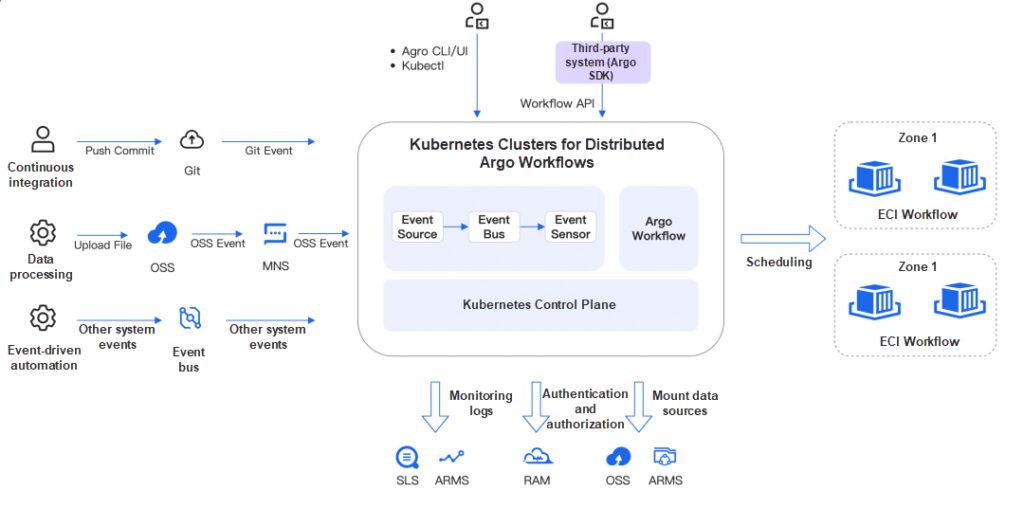
Kubernetes, an open-source container orchestration platform, plays a significant role in orchestrating Big Data workflows by providing a robust and scalable infrastructure for managing and deploying large-scale data processing tasks. In the context of Big Data, Kubernetes offers the ability to efficiently distribute processing workloads across clusters of machines, ensuring optimal resource utilization and performance. This allows organizations to leverage the power of Kubernetes to streamline and automate the execution of complex data analytics pipelines, enabling better handling of massive datasets and enhancing overall data processing efficiency.
Kubernetes has emerged as a leading orchestration platform that excels in managing containerized applications across multiple hosts and environments. In the world of Big Data, the orchestration of applications is crucial due to the complexity and scale involved. The integration of Kubernetes in Big Data workflows provides several advantages that enhance productivity, performance, and scalability.
Understanding Kubernetes
Kubernetes, often abbreviated as K8s, is an open-source container orchestration tool developed by Google. It automates the deployment, scaling, and management of containerized applications, ensuring that applications run consistently across different environments. Kubernetes enables developers to focus on building applications rather than dealing with infrastructure complexities.
The Challenge of Big Data Workflows
Big Data involves handling vast volumes of data that can be structured, semi-structured, or unstructured. Managing such data efficiently requires robust workflows that can handle data ingestion, processing, storage, and analysis. Traditional approaches often struggle with the dynamic nature of Big Data workloads, leading to delays and inefficiencies.
Challenges faced in Big Data workflows include:
- Scalability: As data grows, the need for horizontal scaling increases, necessitating an architecture that can easily scale up or down.
- Resource Management: Efficiently managing various resources, including CPU, memory, and storage, is critical for optimal performance.
- Fault Tolerance: Big Data applications must be resilient, able to recover from failures, and ensure data integrity.
- Deployment Challenges: Moving applications from development to production requires consistent environments, which is often hard to achieve with traditional setups.
Kubernetes Features Supporting Big Data Workflows
Kubernetes offers several features that align perfectly with the demands of Big Data workflows:
1. Containerization
Containerization allows applications to be packaged with all their dependencies, ensuring they run consistently, regardless of where they are deployed. This level of isolation enables data engineers to develop and test their applications independently before deployment.
2. Auto-scaling
Kubernetes provides Horizontal Pod Autoscaling (HPA), which automatically adjusts the number of pod replicas according to the workload. This feature is especially useful for Big Data analytics, where data processing requirements may fluctuate dramatically based on data volumes.
3. Resource Management and Optimization
Kubernetes allows for detailed resource requests and limits for each container, ensuring that applications get the resources they need without over-provisioning. This leads to significant cost savings and resource optimization, particularly in cloud environments.
4. High Availability
The inherent design of Kubernetes promotes high availability. If a container fails, Kubernetes can automatically restart it. In a Big Data context, maintaining availability and reliability is paramount, and Kubernetes excels in ensuring that services remain operational even under failure scenarios.
5. Declarative Configuration
Kubernetes utilizes a declarative configuration model, meaning that infrastructure and applications can be described using YAML or JSON files. This facilitates easier version control and reproducibility of environments, critical in Big Data applications where changes are frequent.
Integrating Kubernetes with Big Data Tools
One of the strengths of Kubernetes is its ability to integrate seamlessly with various Big Data tools and frameworks. This versatility allows organizations to leverage existing investments in technology while enhancing their operational capabilities. Here are some prominent integrations:
A. Apache Spark on Kubernetes
Apache Spark is a powerful open-source data processing engine that significantly benefits from Kubernetes orchestration. Running Spark on Kubernetes allows data scientists and engineers to utilize Spark’s capabilities in a managed environment. Spark jobs can be deployed easily, scaled automatically, and monitored efficiently within a Kubernetes cluster.
B. Apache Flink
Similar to Spark, Apache Flink provides streaming and batch processing capabilities. Kubernetes facilitates the deployment of Flink clusters through Kubernetes operators, ensuring that Flink can benefit from the orchestration features provided by Kubernetes, including scaling and management.
C. Kafka with Kubernetes
Apache Kafka is a distributed streaming platform widely used in Big Data applications for building real-time data pipelines. Deploying Kafka on Kubernetes streamlines management and scaling, enabling it to handle high-throughput data streams efficiently.
Use Cases of Kubernetes in Big Data Workflows
Many organizations have successfully adopted Kubernetes in their Big Data workflows, leading to enhanced performance and efficiency. Here are a few notable use cases:
1. Healthcare Analytics
In the healthcare sector, organizations are leveraging Kubernetes to manage massive datasets from patient records, medical imaging, and research data. By automating data processing workflows with Kubernetes, healthcare providers can derive insights faster and improve patient outcomes.
2. Financial Services
Financial institutions handle vast amounts of transactional data. Using Kubernetes allows them to scale processing capabilities during peak loads while maintaining operational integrity, essential for compliance and risk management.
3. E-Commerce Platforms
Kubernetes has become a game-changer for e-commerce platforms that deal with high volumes of transactions and user data. The ability to deploy microservices architectures allows for better management of the different aspects of the e-commerce process, from inventory to customer interactions. Auto-scaling features ensure that system performance is optimal during traffic surges, like during promo sales or holiday seasons.
Kubernetes Best Practices for Big Data Workflows
To maximize the effectiveness of Kubernetes in managing Big Data workflows, organizations should consider the following best practices:
1. Optimize Resource Requests
Accurately defining resource requests and limits for each container is crucial. Underestimating these values can lead to performance bottlenecks, while overestimating can lead to resource wastage.
2. Implement CI/CD for Data Pipelines
Establishing a Continuous Integration/Continuous Deployment (CI/CD) pipeline for Big Data applications ensures that deployments are streamlined and quicker. Use tools like Jenkins or GitLab CI to automate testing and deployment processes.
3. Monitor and Log Effectively
Use Kubernetes monitoring tools like Prometheus and Grafana to track the performance of Big Data applications in real-time. Leverage centralized logging solutions such as the ELK stack (Elasticsearch, Logstash, Kibana) for effortless log aggregation and analysis.
4. Automate Backup and Recovery
Implement automated backup solutions to safeguard Big Data applications. Kubernetes’ ability to work with persistent volumes means data can be safeguarded against loss due to unexpected failures.
The Future of Kubernetes and Big Data Workflows
The intersection of Kubernetes and Big Data workflows is set to evolve with emerging trends in AI and machine learning. As organizations seek to leverage AI-driven insights from big datasets, Kubernetes will play a pivotal role in managing these complex ecosystems.
Moreover, advancements in Kubernetes itself, such as better support for serverless architectures and enhanced storage options, will further bolster its capabilities in Big Data environments. Organizations that adopt Kubernetes are likely to stay ahead of the curve in optimizing their data workflows for insights and enabling real-time analytics.
Kubernetes plays a crucial role in orchestrating Big Data workflows by providing a scalable, flexible, and efficient platform for managing and automating large-scale data processing tasks. Its ability to seamlessly deploy and manage containers makes it an invaluable tool for handling the complexities of Big Data workloads, ultimately driving enhanced productivity and performance in data-intensive environments.
Related posts:
 What is Big Data? A Beginner’s Guide
 The Five Vs of Big Data: Volume, Velocity, Variety, Veracity, and Value
 Structured vs. Unstructured Data: Key Differences and Examples
 What is a Data Lake? Definition, Uses, and Benefits
 Introduction to Distributed Computing in Big Data
 Understanding Data Pipelines in Big Data
 The Evolution of Big Data Technologies: Past, Present, and Future
 Data Ingestion Techniques for Big Data Processing
 What is Apache Hadoop? A Complete Guide
 Understanding Apache Spark: Features and Use Cases
 What is Kafka? How it Powers Real-Time Big Data Applications
 Apache Flink vs. Apache Spark: Which One is Better?
 Introduction to NoSQL Databases for Big Data
 The Role of MongoDB in Big Data Analytics