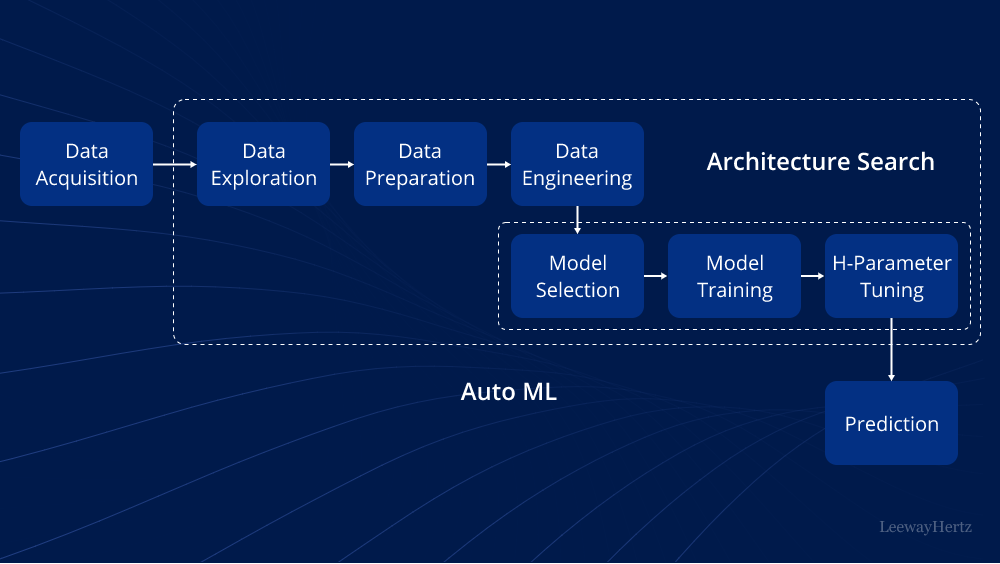
In the realm of Big Data analytics, leveraging AutoML (Automated Machine Learning) has become increasingly popular for large-scale predictive analytics tasks. AutoML allows organizations to streamline the process of building, training, and deploying machine learning models by automating repetitive tasks, thus enabling data scientists to focus on higher-level strategic decisions. This article explores how businesses can harness the power of AutoML to efficiently handle vast amounts of data and extract valuable insights for predictive analytics in the Big Data landscape.
In today’s data-driven world, organizations are increasingly relying on predictive analytics to make informed decisions and gain a competitive edge. With the vast volumes of data generated daily, traditional methods often fall short, leading to the emergence of AutoML (Automated Machine Learning). This technology simplifies the adoption of machine learning for predictive analytics, making it accessible to a wider range of users and organizations.
Understanding AutoML
AutoML refers to the process of automating the end-to-end process of applying machine learning to real-world problems. It covers various aspects, including data preprocessing, model selection, hyperparameter tuning, and deployment. The goal is to reduce the barrier to entry for non-experts while allowing data scientists to focus on higher-level strategy and problem definition.
AutoML tools leverage large-scale Big Data frameworks to process vast amounts of data efficiently. By utilizing these platforms, organizations can harness the power of AI to enhance decision-making and predictive capabilities.
Benefits of AutoML for Predictive Analytics
Leveraging AutoML for large-scale predictive analytics offers numerous benefits:
- Increased Efficiency: AutoML accelerates the machine learning pipeline, reducing the time required to deploy predictive models.
- Enhanced Accuracy: Advanced algorithms within AutoML platforms can lead to models with improved accuracy by identifying hidden patterns in large datasets.
- Scalability: AutoML frameworks are designed to handle large datasets, making it feasible for organizations to deploy predictive analytics at scale.
- Cost-Effectiveness: By automating many of the labor-intensive steps in the machine learning process, organizations can save on resource costs.
- Collaboration: With fewer technical barriers, different teams (like marketing, sales, and finance) can collaborate more effectively using shared insights derived from predictive analytics.
Key Steps to Implement AutoML in Large-Scale Predictive Analytics
Implementing AutoML in your organization involves several critical steps:
1. Define Business Objectives
Before diving into AutoML, it’s crucial to clearly define the business objectives. Determine what you aim to achieve with predictive analytics, whether it’s increasing sales, improving customer retention, or optimizing operational efficiency. This step helps guide the data selection, model building, and evaluation processes.
2. Collect and Prepare Data
Data is the backbone of predictive analytics. The quality and relevance of your dataset significantly influence the model’s performance. Collect data from various sources, which may include:
- Transactional databases
- Customer relationship management (CRM) systems
- Social media platforms
- Internet of Things (IoT) devices
For successful predictive analytics, ensure that the data is cleaned, transformed, and formatted appropriately. AutoML tools can assist in this process through automated data cleaning and preprocessing techniques.
3. Choose the Right AutoML Tool
Selecting the right AutoML tool is critical. Several popular AutoML platforms, such as:
- H2O.ai: Known for its fast performance and ease of use.
- TPOT: A genetic programming-based AutoML tool that optimizes machine learning pipelines.
- Google Cloud AutoML: Offers robust services for model development integrated within Google Cloud.
- DataRobot: Focuses on enterprise-level solutions with powerful automation capabilities.
Evaluate these tools based on their features, scalability, cost, and ease of use to find the best fit for your organization’s needs.
4. Model Development and Training
Once the tool is chosen, the next step involves model development and training. AutoML platforms streamline this phase by automatically selecting the most appropriate algorithms based on the dataset. Key sub-steps include:
- Feature Engineering: Automatically derived features can enhance model performance. Features should be relevant to the predictive task at hand.
- Model Selection: AutoML evaluates various algorithms and selects the one or a combination of algorithms that yield the best accuracy.
- Hyperparameter Tuning: Optimization processes that adjust algorithm settings to improve model performance.
5. Evaluation of Models
After model training, it’s crucial to evaluate its performance. AutoML can generate multiple models and provide metrics regarding their performance, such as:
- Accuracy: Percentage of correct predictions.
- Precision and Recall: Measures the relevance of predictions.
- ROC-AUC Curve: Evaluates the trade-off between true positive and false positive rates.
Choose the model that aligns with your business objectives and performance criteria.
6. Deployment of Predictive Models
Once a model is selected, the next step is deployment. AutoML platforms usually provide options for seamless integration with existing systems. Considerations for deployment include:
- Real-Time Processing: Ensure that the model can process data in real-time if necessary.
- Scalability: The model should be able to handle increasing data volumes as your organization grows.
- Monitoring: Implement monitoring systems to track model performance over time and to detect drift or changes in data patterns.
7. Continuous Learning and Improvement
Predictive models require maintenance and updates. Utilize AutoML’s capabilities for ongoing learning, allowing models to adapt to new data and trends. Establish processes for:
- Periodic Retraining: Regularly update models with new data to maintain accuracy.
- Feedback Loops: Gather feedback from users and incorporate it into model adjustments.
Challenges and Considerations
While AutoML brings numerous advantages, organizations should remain aware of potential challenges:
- Data Privacy: Ensure compliance with data protection regulations such as GDPR when handling sensitive information.
- Data Quality: Models are only as good as the data fed into them; poor quality data can lead to inaccurate predictions.
- Overfitting: Be cautious of models that perform exceptionally well on training data but fail to generalize on unseen data.
Future Trends in AutoML and Predictive Analytics
The future of AutoML and predictive analytics is expected to evolve rapidly. Emerging trends include:
- Integration with Cloud Platforms: The move towards cloud computing enhances scalability and flexibility.
- Explainable AI: Increasing demand for transparency and understanding behind model decisions.
- Automated Feature Engineering: Continuous advancements in AI techniques will enable more sophisticated feature generation methods.
As organizations embrace these trends, AutoML will play a critical role in shaping effective and efficient predictive analytics capabilities.
Leveraging AutoML for large-scale predictive analytics in the realm of Big Data offers a powerful solution to streamline and optimize the model-building process. By automating tasks such as feature engineering, model selection, and hyperparameter tuning, organizations can expedite the development of accurate predictive models, ultimately accelerating decision-making and driving business value. Embracing AutoML empowers data scientists to focus on higher-level strategic initiatives, while harnessing the full potential of Big Data to unlock actionable insights and remain competitive in the ever-evolving landscape of data analytics.
Related posts:
 The Future of Digital Twins in Large-Scale Big Data Simulations
 The Impact of Federated Analytics on Big Data Privacy
 The Role of Causal AI in Understanding Big Data Relationships
 How to Perform Large-Scale Time Series Forecasting with Big Data
 The Role of AutoML in Scaling Big Data Model Deployment
 How to Perform Real-Time Outlier Detection in Big Data Pipelines
 The Future of AI-Powered Data Wrangling for Big Data Scientists
 The Role of Synthetic Tabular Data Generation in Big Data Training Sets
 The Future of Hypergraph-Based Machine Learning in Big Data Applications
 The Impact of Transfer Learning on Large-Scale AI Models
 How to Use Apache SeaTunnel for ETL in Big Data Pipelines
 The Role of AI in Automated Feature Selection for Big Data Models
 The Future of Scalable AI-Driven Big Data Pipelines
 How to Perform Online Data Augmentation for Real-Time AI Applications